Saturday, April 12, 2025

Saint's Row IV: Re-Elected (2013/2022) - Review

 If you're not around to play a game series from the beginning for whatever reason, after a few years you'll be stuck with the first world problem of trying to figure out where to begin. The internet is shock-full of lists asking "which Castlevania is the best?" and "Which Super Mario game should I start with?". There are a lot of thing to factor in here - the series might have crossed over platforms you don't even have access to anymore. It might have evolved through different genres, meaning you have to figure out which ones suit your tastes. It might be unclear how much the games reference each other, meaning you have to start from the beginning to enjoy later parts more.

I've managed to end up having to make this choice recently with not just one but two games I am currently playing. Taking on the Assassin's Creed series I had over two handful of games to choose from (you can click the link to see how that went). Looking at the Saint's Row series I fortunately had less than half of that to choose from, but for some reason I went with the latest one (not counting the reboot).


What was my reasoning? Maybe it wasn't deeper than simply being the game that was on discount when I was looking to try it out. When investigating the older games (1 and 2) they also looked a little more serious and a lot more ugly than what I was after. So the choice for me was really between 3 and 4 in the end. 4 won out for unclear reasons and here I am, wondering whether I made the right choice. Can I ever really undo it by playing the third instalment afterwards?

Either way, the fourth game (this being the Re-Elected version, which includes all the DLC) has not been a bad experience. And maybe it could be interesting to read what the game is like for someone who has no previous knowledge of the series and judges it on its own merits alone. If you think so, read on.

Trying to explain the story of SRIV is not easy. Right off the bat it was pretty clear that things had been going on in the earlier games and this was a continuation on that, or at least so I think. There is going to be a lot of assumptions from my side moving forward here, assumptions and straight out guesses. But here we go; You play as a character who is the president of the world. But pretty quickly you learn that there isn't much world to preside over. Alien forces have destroyed it and caught you and your posse, the eponymous "Saints", in their mind game of a simulated world. It's unclear who they are, where they come from or what their motivations are, but these things honestly don't matter so much. In all the confusion one thing stands out clear as day - everything is just an excuse to allow you to try out crazy gameplay.

It's a very dark game, with the occasional neon.

And in this regard SRIV delivers. I am not generally a fan of games that make it their main goal to be weird, games like Goat Simulator for instance, which seem to be designed mainly for those special Youtubers who get their money from screaming a lot on screen.

But I do enjoy a game that takes an odd premise and still manages to build a somewhat interesting story around it, a game like Octodad: Dadliest Catch is a good example of this. While SRIV might lack a bit in the story department, in the sense that you get the feeling that everything is just a "free-for-all"-excuse for more mayhem, it does deliver on heart and character. SRIV has a lot of both.

The character controls well, and I would even dare say excellent when comparing it back-to-back to Assassin's Creed: Unity, which I as mentioned played simultaneously. You get super powers that allow you to jump very high, run very fast, throw huge objects in people's faces and run up the side of buildings. And that is just mentioning a tiny fraction of all the skills you can play around with after a handful of hours into the game. The skills you get can be unlocked with currency, you can unlock other attributes with other currency. Some are found on the stages, some are got by completing quests. There is a lot to keep track off, but it manages to stay fairly easy to understand and use.


The map of the virtual city is littered with objects to interact with. I didn't understand the purpose to having fifteen shops where you could alter the look on your rides, buy a new t-shirt or load up on more ammo, especially not after a short while into the game where it becomes easy and quick to get around the city. Convenience, maybe? There also seem to be quests that are specifically designed for multi-player, somehow, I didn't get a chance to try these.

The game is overall never a challenge on normal mode, probably veered more towards having fun than giving you a real challenge. When I died it was mostly to fooling around and not caring, than genuinely trying to solve something. The only time the game made me scratch my head and reload over and over, was during a quest where I had to fight Giant Paul the Giant Soda Can. That guy blasted me with a laser that was essentially a none-dodgeable one-shot, even on normal difficulty.

You can tell that your character and their gang has a long backstory together, a lot of the quests allude to that. I often felt that it would've been fun to have played the quests and scenarios that this game references first, but the quests often hold up gameplay wise on their own, at least enough to be entertaining even if you don't get that extra oumph from fan service and nostalgia.


And there is a lot of whacky shit to do, that's for sure. I love that the game designers have not held back in the brainstorming sessions. Even character creation allows you to create something with pink chrome skin, if you like that sort of thing. In order to interrupt the virtual world that the alien Zin (as they are called) have created you need to break the code like some Neo on crack. You get to hurl your body, literally, against objects, save Santa from Evil Santa, use all kinds of weird weapons and have a gang of Gingerbread Cookies be your sidekicks. I can't emphasize enough that the pitch document for this game probably just had the words "MORE IS MORE" written in big, bold, red letters.

But generally it works, I am entertained. I like the characters, though I barely know them, and I have fun with the insane things that we get to do. Until at some point I can't help but feeling that even this golden treadmill, is still nothing but a treadmill. Am I asking for a sense of direction in all this mayhem? Maybe. There is just so much to do, so many characters to help and so many virtual pedestrians to run over that it actually manages to feel a bit... empty. When I am given these many toys to play with, I end up feeling like none of them are fun in the long run.

I don't want to tell SRIV to get a grip or to calm down. I think SRIV is doing exactly what it should and it is doing it well. But for us mere mortals it gets a bit overwhelming in the long run. SRIV is an all-you-can-eat buffet where after ten minutes of browsing you realize you're really just interested in the baguettes.

Sunday, April 6, 2025

Limbo (2010) - Review

I personally think the indie game landscape is one of the best and freshest things to happen to the video game world. It was looking quite dark there for a while in the mid 00's, with triple A developers only hinging their money on the safest of bets, ergo the most predictable of games. The video game industry seemed to be caught in a loop of trying to predict and deliver exactly what video gamers wanted, which only led to games that no one fully enjoyed. Things were glum indeed and suddenly, almost as by design, developing tools became accessible and user friendly enough that any basement game designer could give it a go. It was a beautiful full circle back to the very dawn of computer and video games, when most of them were made by people just playing around on their machines, trying to create something that they themselves wanted to play and not necessarily make the most money out of.

Limbo, released in 2010 by Playdead, wasn't among the very first indie games, but in my mind it definitely belonged to the first batch of games that showed players what indie games could accomplish that triple A developers were missing out on or were overcomplicating. It was a game that dared to be simple and concise, something that video game designers seemed to have almost forgotten the art of. Instead of moving towards even more content, even more open world, even more customization, Limbo was a game that removed all of that and told the simplest of stories with the most straight-forward of gameplay, like the darker twin of Super Mario Bros.

I was deep into my World of Warcrafting when Limbo was released and had little interest for it at the time. And in all honesty, the only reason I decided to eventually check it out was simply because it still lingered in the back of my mind as a game that was part of a big moment in video game history, and as such at least something I should know a little more about than the name and that it seems to have huge spiders in it.


Puzzle platformers are really not my thing, I must admit. I also tried Braid and didn't like it, so I didn't have high expectations for Limbo either. I also suck at Mario games, but those I still enjoy playing every now and then. My problem with indie puzzle platformers have often been that focus has been so much on making interesting puzzles, that it seems that the most important part - good platforming - has been lost on the way. Nothing is more frustrating than trying to solve a puzzle and constantly failing because your character doesn't control well enough. This was one of my issues with Braid.

I found this to be part of the issue in Limbo as well. The character, who seems to be a young child lost or running through dark woods, controls just fine until you get to parts that require timing. The controls are super simple, you can go left, right, up and down and with "ctrl" (on computers at least) you can grab things. The child will automatically cling on to ropes and edges if you're close enough. That's all there is to it. But it doesn't always work well enough and your character will suddenly do a short jump where you needed a long one, or fail to climb over an edge in time. I'm not saying the controls are badly programmed, but they are not tight enough for what is requested.

So you have to be prepared for a lot of trial and error. Limbo will throw traps at you that reverses the rule of a previous trap, which just feels devious. Or maybe hilarious, depending on your mood for the evening. Some times the puzzle is on a time limit for varying reasons (rising waters being one) and you don't get much time trying different ideas. Some times you know exactly what you need to do but fail at execution for unfair reasons, see above.


I am not entirely sure what Limbo is trying to tell with the atmosphere, but there must almost be a subgenre of games that has the "lonely in dangerous woods"-feel. If you like the feeling of being alone in the world, everything out to get you and nothing making sense (and why would you, it literally sounds like a nightmare), while solving puzzles, I can recommend checking out the games Rymdresa and Year Walk as well. The black and white in Limbo really works in its favour, and it probably helps hide the fact that Limbo itself feels like only half a game.

Because something struck me as interesting while playing Limbo - I am not so sure Limbo would've been noticed at all if it had been released in todays indie landscape. I am in fact sure it wouldn't be. Limbo in itself isn't much of a game, really. You run in one direction and  But what it represented when it was released meant a lot more than the game itself. It was what the game industry needed at the time. But now that we have indie games galore, we're spoiled with out of the box ideas and underdog design choices and a game like Limbo doesn't seem like a game that's out on a limb(o) anymore. In todays indie world Limbo seems a bit simple and tame.

But it wasn't back then. Back then it represented fresh and daring thinking, and no one can take that away from it. If you're like me, a bit curious about gaming history and gaming milestones, you could give Limbo a few hours of your life. Otherwise I think it's enough to just know what it once was, and enjoy the fruits of what it sowed.

Wednesday, March 26, 2025

Assassin's Creed: Unity (2014) - Review

 The Assassins Creed franchise has been actively lingering in the back of my brain ever since the first one was released in 2007. For some reason I never really got into it, even though the gameplay looked like something that I would enjoy - stealth and parkour. Since the first game came out the series has grown to a veritable smorgasbord of games and maybe it's taken me so long to get into it because I didn't know where to start. My hesitation has only added more games to the list.

Do I start from the beginning? The first games can be full of dubious gameplay and game design choices that make them difficult to enjoy with modern eyes and quality of life-wants.

50 shades of brown

Do I start in the middle? Where did they iron out the most kinks, where did they nail the story? 

Do I start with the latest? Who knows what good games I miss jumping the line all the way to the end? I could've made the smart thing and checked some list of "best games in the Assassins Creed series". But instead I did a pick of a handful with cool sounding names from a Steam sale a while ago, and decided to start with the oldest one out of that bunch. That game was Assassins Creed: Unity.

While I didn't know much about the game going in, I knew enough to have a general idea and expectation. The game largely fulfilled those expectations. The game is mostly about stealthing and parkouring. What I didn't expect however were how badly designed the game would be in those core areas specifically.

It seems clear that Unity expects you to be a returning AC player as it doesn't explain much about the premise of the AC game series. Because of this I can't really say much about it either - you play as a guy named Arno during French Revolution Paris. From being a sort of nobody you somehow become part of an assassinations guild, it is never explained where Arno gets his superhuman capabilities of climbing buildings. In actuality however, you're some guy in present time, hooked up to some machine that allows you to control Arno in a sort of virtual reality time travel. Some evil corporation is after you in this virtual world, though during my 20 hours with the game that never came to matter. Some of the quests and stages are centered around this fact that the world you run around in is actually inside a computer, or something like it, but that's the most you'll ever notice. Mostly you spend your time running up and down the streets of 18th century Paris, scaling walls and trying to complete different quests and tasks given to you.


And this is both one of the best and the worst things about AC: Unity. I love the detail of Paris and as someone who is quite interested in history it was fun to just run around and pretend to be there. I've heard that Ubisoft overall has tried to be as historically accurate as possible, while also trying to make a fun game and on one of these things I find that the game excels. Even though the game is now 11 years old it's beautiful and feels alive. They've made a lot of nice little scripts running throughout the city that make it feel like all the NPCs moving about are minding their own business, or mostly reacting appropriately to your often weird behaviour.

The story also has the potential to be interesting. It starts with a sequence about the Templars in the 12th century (or something like it) and this is continued in a struggle between the assassinations guild and somewhat unclear antagonists in the 18th century. There is a lot of optional information about things you come across and they were always a delight to read, with in-depth texts about characters, locations or situations. Some of the quests are quite interesting, like the murder mystery ones where you have to figure out who is the culprit and accuse the right person to receive the best reward.

A lot to do, not much of it fun though.

Combat is serviceable, with a possibility to block or dodge enemies and use different tools like smoke bombs and arrows to increase your advantage. Being able to jump people from above and stealth kill multiple targets is fun and useful.

Unfortunately it is all ruined by the one thing that needed to really work, the controls. If you're going to make a game that is so much about handling yourself, jumping from one building to the next, climbing up the side of clock towers and hiding from evil guards, those things need to not constantly be what you fail to do.

After having played other games that have some element of climbing, stealthing and jumping through hoops (Shadows of Mordor, Dishonored) I can say this game is by far the most poorly executed. In fact so bad that after 20 hours of playing, and a particularly frustrating sequence trying to kill the Beggar King but having to restart the mission around ten times because Arno wouldn't do what I wanted him to, I decided I didn't want to play this anymore.

It is clear that Ubisoft bit off more than they could chew. Or maybe the game was just exceptionally poorly optimized to my setup. I played it with keyboard on PC, and I toyed with the idea of trying to use a controller. But the problems I had with the controls didn't seem to stem from the control scheme, but how Arno interpreted my input and interacted with the world around him. It seemed almost arbitrary whether he would jump on to the next object or just randomly hurl himself off the wall and onto the street. Hiding behind objects to avoid being discovered I often ended up being stuck. Don't get me started on trying to get through windows, which was practically impossible. This quickly gets extremely frustrating when you have a handful of guards behind you shooting you in the backside.

And it doesn't end there;

  • The menu system is incredibly obtuse, trying to find information about the quest I was on was way harder than it should be. 
  • The minimap is littered with symbols indicating things you can do, but the overview map doesn't always correspond or contain the same symbols (I am aware you can filter), making it confusing to use. 
  • It's way too unclear how you gain currency to unlock skills or improve your weapons.
  • Even though it is supposed to be a stealth game, it is in no way clear how visible you are at any given time. While you get a good tool in the "hightened senses" that allows you to see enemies through walls, it was impossible to judge if someone was going to spot you based on light sources or distances. Some times I crept around in a fully lit church having absolutely no idea why some guards spotted me and some didn't.
  • I really don't like Ubisoft Connect...
I just felt like for every moment I got to enjoy, the game had to give me two moments where I was extremely annoyed. That is just not a good enough ratio. It also doesn't help that a lot of the side quests got repetitive and I decided to try to get through the game quickly by focusing on the main story. But after the above mentioned harrowing experience of a complete communication failure between me and Arno I knew that it wasn't about me getting comfortable with the controls and it wasn't going to get any better.

This doesn't mean I am giving up on the AC series however, I still have a few games from that sale to check out eventually.

Thursday, March 6, 2025

Day of the Tentacle Remastered (2016) - Review

Deciding to revisit some childhood memories by replaying old Point & Click (P&C) Adventure games with my kids has turned out to be a blessing and a curse. I'm always happy to see them enjoy "real" games, as I like to think of anything that isn't just clicking and combining random stuff (wait a minute, that describes the average P&C game).

But it turns out they enjoy them a lot more than I expected them to. Maybe more than I ever did when I originally played them, probably fueled by the fact that we get to complete the games unlike what I managed on my ownsome. Especially my 6yo daughter loves the experience of sitting together and trying to figure out the puzzles. Now she nags me every day for us to play some more. A blessing and a curse.


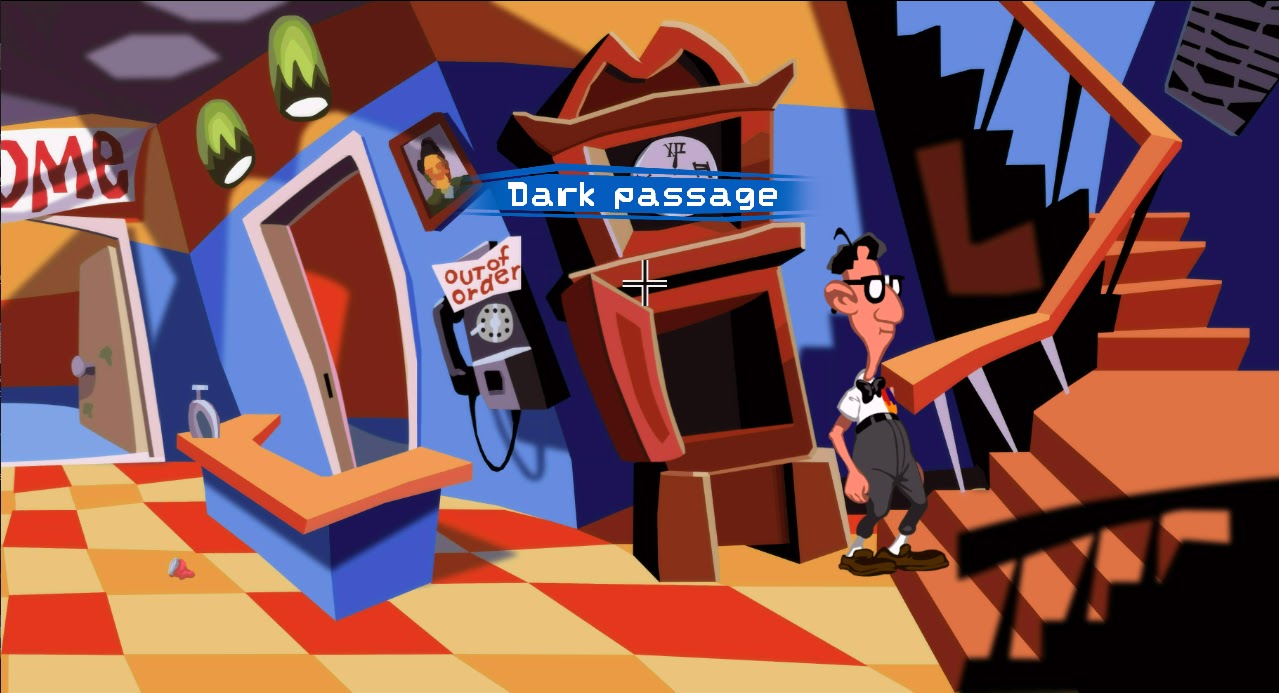
Unlike my memories of Secret of Monkey Island, I remember clearly not getting very far into Day of the Tentacle as a kid. Having replayed it now as an adult, I really can't blame my child-self for failing at this. Day of the Tentacle epitomizes everything that I worry about when playing a P&C game i.e the puzzles being obscure to the point of almost being impossible to solve. Day of the Tentacle requires some next level out-of-the-box-thinking to finish without a guide and there are puzzles in there that will haunt me forever. Oh and just a warning here, I will give some examples of these puzzles so if you haven't played the game and don't want any tips, beware.

Day of the Tentacle is technically a sequel to Maniac Mansion, a game I have never played. Fortunately it only vaguely references that game (at least to my knowledge) and it doesn't feel like you need to know anything about Maniac Mansion to fully enjoy this game. Because even though Day of the Tentacle is a P&C game that is hard as nails, it is very fun and probably one of the best examples of the comedy from writers Tim Schafer, Dave Grossman and Ron Gilbert who also made the beforementioned Monkey Island game and the sequel to that.


The original Day of the Tentacle was released in 1993 and the remastered version adds some updated graphics and a very enjoyable commentary track that runs throughout the game as you play it. This style of updated graphics worked so much better than the one they used in The Secret of Monkey Island, as they've basically kept the original style but smoothed out the pixelated edges which makes things a bit easier to see.


You control friends Bernard, Hoagie and Laverne as they get thrown across time to stop the evil purple tentacle from taking over the world. Hoagie gets stuck 200 years in the past and Laverne 200 years in the future, while Bernard stays in the present. A big part of the gameplay is adjusting the timeline so that whatever Hoagie does in the past changes conditions in Bernard's or Laverne's timeline. This is a very fun concept and used brilliantly throughout the game, it also ups the ante for your guesses on how to solve different problems. One of my favorites is when Bernard puts a sweater in the tumble dryer for 200 years so that when Laverne gets it in the future she can use it to warm up a hamster that has been frozen for 200 years. 

The controls are the good old SCUMM controls with the option to use different verbs with different objects in your surroundings, verbs like "push", "open" or "pick up". In the remastered version you get a wheel of options that works very well, much better than solution they went with in the remastered version of the Secret of Monkey Island.

When I played it as a kid I never got further than getting Laverne out of the tree. Finally getting to play through the game properly was exciting and fun. I remembered some puzzles in the beginning but very quickly we got stuck and we pretty much had to use a walkthrough for 80% of the puzzles in the latter 3/4 of the game. 

Like any good game, a good P&C game needs both a good story and good gameplay. Day of the Tentacle delivers. I usually get annoyed when I constantly have to consult a walkthrough, but the characters and the story of Day of the Tentacle kept me curious and I didn't mind checking lists. 


But how hard are the puzzles anyway, you might wonder? Let me give you one example...

*deep breath* In the future, Laverne needs a tentacle to move from the place he is guarding. To make him move she needs to make him chase after some humans. To let the humans out of the prison you need to remove the prison guard. To remove the prison guard you need to give him a dinner invite. To get the dinner invite you need to win the human exhibition contest. But Laverne has no human to compete with. So you get a mummy in an upstairs room and put roller skaters on him so you can roll him around. You also need a name tag that you get from one of the other guys. Then you need Hoagie to send you pasta that he finds in a cupboard, use it as hair on the mummy and comb it with a fork. All this is to win one of the three competitions needed.

There are definitely puzzles in this game I would've never been able to figure out or even guess at.  Maybe not even figure out with the old and tried tactic of just combining everything in your inventory with everything you see. Since you play as three different characters, in three different setting and with three different inventories, it just makes the variables so much larger. I don't feel dumb playing this game, I just accept the whackiness of it.

But fortunately everything else about the game is so well done and written, you forgive it and you want to continue trying. I definitely did as a kid, I threw myself at the problems many, many times and I even managed to figure out that you needed to paint the Kumquat tree fruits red so that Washington will think it's a cherry tree and chop it down, meaning it disappears in the future and Laverne falls down.

But then I couldn't figure out that Laverne needs to send the diagram of a tentacle to Hoagie so that he can give it to the woman who creates the American flag, turning a flag in Laverne's timeline into a tentacle costume so that she can move around freely. Yeah... I never got past that part. Until now.

If you tell me you've played through Day of the Tentacle entirely without help, you have my eternal respect. It is probably the most difficult P&C game I have played, simply because of the somewhat random and jokey nature of the puzzles.

But the game is full of memorable characters and gaming moments that will make it worth your time and frustration. The game manages to stump you but make it all the more rewarding when you figure something out. It deserves its place as one of P&C games finest, especially considering when it was released. There have been many good P&C games since then, but few as fun and funny as this one.

Monday, March 3, 2025

Grape Escape - Board Game Review

What's in a name? That which we call a board game, by any other name would be as fun.

Or would it? I am guessing I am not the only one who has once or twice pondered, what even counts as a board game? In Swedish we make a distinction between games played with a board, i.e literally board games (brädspel), games played with cards (kortspel) and other type of table top games (sällskapsspel). My brother was annoyed when I called Arboretum a board game, because even though you'd might think it would count as a card game he thought of it as a table top game.

Semantics, one could say. And one would be correct, in a way.  In the end all that matters is that it is fun. But maybe not, because when I tell my family I want to play a board game and we end up playing Mouse Trap, I feel cheated. Not because it is bad, and it is quite bad, but because it doesn't feel like a board game to me, but more like a toy.


I realize a lot of the board games I wanted as a kid were actually these semi-toys like Mouse Trap and Ghost Castle. And Grape Escape. For some reason I never really got to play them. They were always out of reach. Some friend might have had them, maybe I saw the ad for them. They seemed to so cool, like so much fun. So when I saw Grape Escape in a Second Hand store I had the opportunity to give in to my inner 10- year old. Of course I had to do it.


I should've known better though, having tried Mouse Trap and knowing what a disaster that is.  Mouse Trap is neither fun as a game nor as a toy. While the idea of a Rube Goldberg machine that you can set off to trap your fellow players is an interesting one, the execution is extremely poor. The slightest cough or vibration sets off the trap meaning you spend a lot more time trying to set everything up than actually playing, or having fun. I guess this explains why I never got to play them as a kid, adults around me felt the same way then as I do about it now. When my kids asked to play Mouse Trap I had to work really hard not to let out a huge sigh of boredom. I am glad they did not ask for it often.


Grape Escape, released in 1992 (this Swedish version in 1993) has a simpler machine, for better or worse, and instead you get to cut, saw, crush and mangle little grape figures made out of clay. The game itself is beyond simple - roll a dice and move on 1-4. One side allows you to jump ahead on the board and one side lets you operate the grape crushing machine. Getting through the board takes no time at all and often you just end up trying out the different ways of maiming your grape instead of actually playing the game - forget teaching your kids right from wrong with this game, it's just about having fun destroying things.

Once you've done that though, there isn't much more to it. Yet again it is way more hassle setting up the machine than you'll end up having fun, and I doubt that there is much longevity in the concept even for the most evil little child. One of the main issues is the instability of the structure itself. It's probably not an easy thing to design something that is supposed to work with some few plastic parts and be able to cut through clay grapes without harming any actual fingers. But it's also not easy enough to put together for young kids to play with it on their own, unless they literally just play with the parts. Putting the whole machine together and making sure things don't pop off every three seconds takes some brain power and steady hands. Kids get just as frustrated as adults trying to operate the thing.


The end result is something that is prone to fall apart and not really good at the one thing it is supposed to do - smash grapes. But it does it somewhat well enough, especially if you give it a helping hand here and there and so it provides some 20 minutes of chuckles. 

Is it worth keeping around the huge box for though? Definitely not, like Mouse Trap this game is not a keeper.