Showing posts with label 1995. Show all posts

Tuesday, June 16, 2026

X-COM: Terror from the Deep (1995) - Review

I have mentioned this before: When jumping into a game series I haven't tried out before there is always the question as to where to begin. The first game? The reboot game? The best game? With Assassins Creed I just picked one at random (Unity), and that was a mistake. With Saint's Row I picked the one that looked like most fun (IV) and that worked out pretty well. With Star Control I started from the beginning and that ended very quickly...

Here I am, doing it again. I decided it was time to check out X-COM even though I am no big fan of strategy games (except Settlers 2 which I love, and this odd little game I tried ages ago called Steam Marines), but I have heard so many good things about these games that I figured I needed to find out what the fuss was all about. What caught my interest was talk about how you invested in your fighters, always worrying that you would lose them. Then, of course, Mario + Rabbids: Kingdom Battle really put X-COM in the forefront as being its inspiration. While I never wanna lay my eyes on a Rabbid ever again, it only further increased my curiosity towards X-COM.

So I looked in my library to see which games I owned and it turned out I had the first five to choose from (skipping First Alien Invasion). The very first one, UFO Defense looked too old-style for me, so I opted for the second oldest - Terror From the Deep, released by MicroProse (famous game developer also known for Sid Meier-games, the Civ-series and MtG: Duels of the Planeswalkers to mention a very few) in 1995 for MS DOS.

As I boot it up I am immediately thankful that I can control it using my mouse, and not some odd keyboard combination of keys. Off to a great start, because with these old games from the 90's it really is the wild west when it comes to gameplay controls and I never know what it's going to be like. Unfortunately it can be a big reason that some of the older games are difficult to play. I am greeted by some great, creepy music that sets the tone right from the start. I am a sucker for some good atmospheric tunes and XCOM TftD does it well. There is a threat lurking, somewhere, and I need to root it out.


The game starts me off by asking me to pick where to build my base. It has to be somewhere underwater, which makes sense based on the title of the game. Clicking around in the menus I can access a "Geoscape" which allows me to look around on the surface of the Earth. At first I have no idea why I would want or need to do this, because as will become very clear, the game doesn't explain a single thing to the player. I am assuming this is because it originally came with a thick manual, but unfortunately the version on GoG doesn't (old games on GoG in fact often come with the original manual, but for some reason this one doesn't). 

For that reason I decide to simply learn as I move along. Best case scenario I will learn by doing, worst case scenario I will fail horribly without knowing why. In this Geoscape scene I can choose to "Intercept". It's the first button on the menu so I click it. Apparently I have submarines that I can launch around the globe, so I give it a go. It seems straightforward enough and I can also ask my subs to do things like patrolling, though at this point I have no idea what will happen if I do. The subs need to refuel and do so automatically, it also seems like my base can't run out of fuel. I also discover the time buttons, which allow me to choose at which speed time moves forward. The options are plentiful, I can move at 5 second increments - i.e very slowly - up to1 day increments, which is the fastest. I stick to 5 sec for quite a while before I dare try to move faster, and it's not until I do that things actually start happening, because TftD is a game that values its slow pacing. As soon as something does happen though the time moves automatically back to slow, so that you have plenty of time to make your decisions - a very welcome game mechanic.

She's a beauty, she is.

Continuing my exploration of the menus I find where I can actually go to my base and do some good old base-building. The menu here is pretty self-explanatory and familiar even if you're mostly into more modern games. I can choose to do research and allocate researchers. I can choose to manufacture and allocate technicians. I can expand my base, gear up my team, recruit more people and a bunch of others things that I am not sure of. I am in fact not sure of anything, I just click around and see what happens.

Suddenly I get the message that an alien sub has been spotted. I can send my sub to intercept, which of course I do. I get the mission briefing that I need to neutralize the alien threat and try to find alien technology if possible. I can always choose to abandon the mission if I feel like but I guess that isn't something I should strive for.

Intercepting aliens moves you into an isometric, top-down view of a more classical action strategy style. I've got my squad of marines that are ready to move out and a bar of buttons to order things around. Yet again I have no idea what any of the buttons do, but figuring that none of them are likely to cause me to explode I try them out at random. They do the obvious things, open up inventory (which also lets you pick things off the ground like in many CRPGs, move between characters and between layers of the battle field (layers being height differences). I move my characters simply by clicking on them and then where I want them to go. They both seem to have something similar to action points, dictating how much they can perform within a turn, and something similar to stamina, which I think is affected by the quality of the terrain. It also seems my marines get tired after some fighting (who'd have guessed?!) and start walking extremely slowly. Or maybe they are weighed down? It is anyone's guess.

Underwater, no one can hear you scream.

I frankly love the graphics of this isometric view though, it's for the most part clear what I am looking at and the sprite work is beautiful. All my little marines are named and I can see what gear they are hauling, though I have no idea how useful any of it is. I can without much trouble see that none of them are wearing much more than a pretty basic weapon and what I think are throwing weapons (they all automatically wear what they need to be able to breathe underwater), so no armor. 

I move my characters around the field and notice that if I move a character that is out of screen view, it will teleport into position. It is only when I look at them they go through the full motion of animating their movements. This is also a welcome function since this saves you from just looking at a screen waiting for your marine to get into position. Once all my characters have moved and I end my turn, the aliens get to do their turn, hidden from me. Unless I have spotted them of course. Just like in Heroes of Might and Magic.

The first aliens I encounter are tiny things that I one-shot with trouble. They also aim like Stormtroopers so I make quick work of them. My son suggests I shoot some stuff inside the alien space ship, which makes things blow up and incapacitate two of my marines. Thanks kid. But it is cool that the environment is interactable, I really like that because I am thinking it can probably be just as easily used to my advantage.

Not for the claustrophobic.

Hyped on my easy win over the little aliens and coming back with some alien artefacts to research on I quickly set out to discover more aliens to kick back into space. But then I learn that TftD is not as gentle as I first thought. Wrestling my subs turns out to be tricky, I am unclear whether I have to boat around the oceans and patrol to come across aliens or not. When I do my subs inevitably have to come back to refuel, and that is also inevitably when the aliens show up. The nations of the world who decide on my funding each month aren't happy that my subs sit back in the base refueling instead of coming to the aid of the people of the world. Neither am I! 

Then, when I finally catch up to another alien sub, I come across some other aliens who definitely don't play nice. Maybe they realized that sending their weakest troops didn't do them much good, because whatever they're sending out now can easily one-shot all my marines as soon as I see them. There is just no chance for me to fight them, and so I rather flee than send my troops into an early grave. The tables have turned. So I start to think. My marines clearly need more of everything to fight those guys - armor, better weapons and health packs. So I start researching those things. And maybe I can try to grind some of those weaker mobs when I come across them, for materials, or whatever they drop.

The game can feel a bit unfair at times. Just stepping out of my sub I get murdered by something off screen. Good bye Malory, it was nice knowing you. I guess that is the harsh reality of alien warfare, but it is difficult to know what I could've done differently. In another mission I find out the hard way that the weapon I decided to bring only works underwater, which I happen to not be. Well... that sucks. In some missions you are supposed to save civilians which seems like a fairly impossible task, as I hear them getting slaughtered in the distance. 

But otherwise there isn't much I don't enjoy about XCOM TftD, and the things I don't like are because I don't know the mechanic yet. For a game that's over 30 years old it plays surprisingly modern. Nothing is explained, but it's also quite welcoming to just try things around and see what happens. It is also a very slow paced game, which requires you to tinker, add a thing here and there. I was already expecting to have to do a few restarts to get the hang of it, but I have in fact survived longer than I thought I would. Usually money is the first thing that goes out the window but the slow pace semi-tricks me into thinking I am doing ok although only a short amount of time has actually passed in-game. In this it is similar to one of my all-time favorites - Settlers 2 from 1996.

This is how you do it.

Fortunately, nowadays a manual is only a quick AltaVista search away. The manual is actually really instructional, showing how to get through the different parts of the game step-by-step, just like a tutorial. An IKEA manual would be proud. It is to the games credit that I got most of the steps from the manual just by trying things out dynamically in-game.

To modern sensibilities the feedback-loop is probably too slowly tuned on XCOM TftD. Even though there is always a feeling of something to do, the sense of real successes are, at least initially, far in-between and hard-earned. If this sounded like it could be your thing, but maybe want something with a quicker turn-around, I can highly recommend FTL: Faster Than Light. It retains the same feel of tinkering and micro-managing, and high level of failure (in a good way!). But for a game from 1995, X-COM: Terror from the Deep is a banger.

Saturday, November 23, 2019

Albion (MS-DOS) - Unfinished Playthrough Review

This review contains spoilers for this 24 year old game, so beware.

Albion is the kind of game I wish I had come across 20 years ago, when life was... more full of time. I so wish I had the skill and patience for it because I know I could enjoy it greatly if I gave it the proper amount of love. There is a lot to like here, but it's buried under gameplay that doesn't jive with me anymore.

Albion, released in 1995 to MS-DOS and not to be confused with some other game named Albion Online, is a role playing game developed by Blue Byte. The German video game company Blue Byte are maybe mostly know for their Settlers series, at least by me but Albion and the Settlers couldn't be more different.

Maybe the inspiration for Avatar

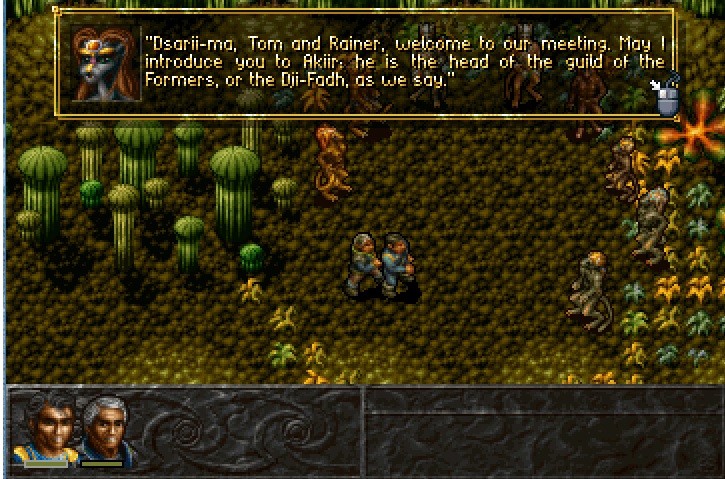
The game takes place a couple of hundred years into the future and seems to be a pure science fiction game at first. In it you play as space ship pilot Tom Driscoll who is sent out on an expedition to scout out resources for his home ship. He and his co-pilot end up crashing on the planet which, contrary to reports, turns out to be inhabited. And not by any kind of life, but advanced and intelligent humanoid cat-people called Iskai.

The Iskai rescue you from your wreckage and you're quickly thrown into a plot where an important Iskai is murdered, you being outsiders are the first to be suspected, and the only way for you to get out of the mess is to uncover who the real murderer is. This is only an excuse to get the story going however, giving you both means and motivation to travel around and discover more about the Iskai race and their planet.

You'll quickly find that there is quite a lot to see and explore on Albion. The Iskai and their planet really feel well fleshed out and thought through, it is a world you want to know more about and definitely save from the threat of exploitation that looms from your home ship.

Visually and audibly the game sells its ideas too. While the audio can get a bit repetitive, this is 1995 after all, the visuals are colourful and bright and lovely to look at. Most of the time you have an idea of what you're looking at and when you don't it's not because of bad design but because it's alien to you.

Initially the game plays out with a top-down perspective, and you can choose to control your character (at least in my GoG version) either with the arrow keys or by dragging the mouse. Personally I found that the arrow keys worked a lot better since it ended up controlling more accurately. At the very beginning, when you're still on the space ship and preparing for your trip you play alone but it won't take long before you get party members and you can choose to control either one of them.


Soon you'll discover that instanced areas, such as cities and dungeons (but not the space ship for some reason), use a first person perspective similar to Doom. At first this confused me and it took me quite some time to get used to controlling myself this way. While eventually you get used to it I would've much preferred it if they had just kept the top-down view throughout the game. The first-person perspective makes it so easy to lose track of where you are, you have much less overview of your surroundings and I spent a lot of time just feeling lost. It is fortunate that there is a convenient map to use that allows you to see which direction you're moving, because you're going to need it a lot.

I am not sure what the thought process was behind the first person perspective areas, maybe they wanted you to have a more immersive experience. While it's not horrible I really do think the game would've been much better without this style. The first Iskai city you come to is pretty large, with many different shops and guilds worth visiting and I spent way too much time just trying to find my bearings.

I have no idea where I am

Combat plays out in yet another fashion, in which you're moved into a grid-like area where you move your characters on the fighting field like on a chess board. You can choose to do a number of actions each turn and there is both melee, ranged and magic combat in this game. Combat is pretty straight forward with your character swinging (shooting) away at the enemies as you command them. Some things are more obscure, like the fact that you can use items during combat. It's easily missed but on the other hand once you realize this it makes the whole combat experience one that works well enough.

You will be bad at it to begin with though and this is where one of the bigger flaws of the game becomes clear. Being designed according to the older school of "git gud", it is very easy to not only venture into areas that are well above your ability grade, but also to completely miss areas and items that are essentially crucial for your continued existence.

While the story is well paced and I rarely found myself stuck as to what I had to do next, it is too easy to miss things that are really helpful in your endeavours. Just after I had crashed on the planet and I found the first dungeon I just kept dying to some mobs that I found in there, also the first enemies I had even encountered and fought in the game. At first and for some time I felt really frustrated. How could the game already be so difficult that I didn't feel like I had a chance against the very first enemies of the game? Had I missed something?

The combat is actually well designed, too bad it's so dang hard.

Turns out, I had. First of all, apparently there was an entire area on the space ship that I could've gone to, which would've awarded me a very useful weapon even before I crash on the planet. But it is entirely possible, even stressed, to just continue with the story. At no point is there a hint or indication that there are other areas to check out in the space ship. The only way you'd find it is by ignoring the call to go to your launch and wander around exploring.

Usually I would enjoy gameplay that rewards curiosity, but in this instance it was too well hidden and I only ended up feeling snubbed of something I really needed.

Secondly, as I end up looking at a walkthrough I find out that these first enemies are optional, but it's definitely not something that is particularly clear. As you move through the dungeon there is a possibility to trigger a cave down that traps you with the enemies, it happens if you just move through the dungeon normally as one would do. What you're supposed to do though, especially if you're nowhere near ready to fight the enemies (which you don't know yet since it's your first combat), is to avoid triggering the cave down and not venture further into the cave.

Realizing at this point, some hour into it, that the game had already tricked me twice I felt a bit annoyed. There is definitely a fine balance that needs to be struck between rewarding curious players, and punishing the not so smart ones (like me). In Final Fantasy VII it is possible to find a lot of secrets that are cool and useful to you. But they don't just require you to be lucky enough to find them, for almost every one of them there is some component of extreme farming or skill involved to acquire these rewards. Furthermore, the game is entirely possible to beat without too much trouble even if you never find a single one of these secrets.

All Iskai furniture are made of plants, it's pretty cool.

In Albion however you realize that you missed a really important item just because you happened to not take the right turn at some point, and there is no going back for it either. You didn't just miss out on a fun item, you've missed out on something that makes a huge difference to your gameplay.

It is also too easy to stumble into areas that are way above your capabilities and there is little way to know if you're just doing something wrong or should head in another direction. Mostly it turned out I just really needed to farm for more skill and levels.

When it's so easy to get lost, die and have to start over it makes it all the more annoying when you know you've missed some item that could've made it so much easier for you. It makes me feel like a bad player, and that is pretty much the opposite of fun.

The inventory system didn't give me much trouble though.

Which is unfortunate, because I really do feel like so much about this game is great. There is literally a whole world waiting for you to be explored. A world filled with interesting characters and places to meet and see. There is a story that, at least for as far as I got, has a lot of potential to be really interesting. Not only do you realize that the planet you're about to exploit is actually inhabited, you eventually end up finding other humans, living rather humbly, on this planet as well. Where did they come from?

But the gameplay and world design ends up being too punishing for me. What killed it for me was when I set off on a boat toward another continent to continue the story. As I get there I find that I can barely move anywhere without really having to struggle for my survival. Yet again a walkthrough explains to me that unless I've come to a certain level and acquired certain skills there is no point in me going to this area yet. But how was I to know this? Grinding for levels and money is painfully slow and arduous and the prospect of having to do this throughout the entire game just put me off it, even though the story and world really intrigued me. Just watching let's plays of it makes me really want to give it another go again.

In the end I still want to recommend Albion. For a 1995 game it is actually pretty ambitious and if you're one who is more familiar and used to the older style of game design I think there could be a lot of fun to be had here. Me, I guess I have to give it another chance when I am a pensioner and have more time and patience. The game deserves it.

Images from: Private, gamesnostalgia.com, hardcoregaming101.net, mobygames.com.

Sunday, July 3, 2016

Throwback Game Review - Suikoden

By the way, there will be spoilers...

Suikoden is another RPG series I had completely missed out on until recently. Well, that is partially true since I actually bought Suikoden V when that was released, but was gravely disappointed with it and never made it more than a couple of hours in. But eventhough I had tried that game, or maybe because of it, I knew very little about the game series. I guess that game (Suikoden V) also somewhat dampened my interest to know more about it, at least until I had checked out other, more interesting looking series first. That changed some month ago however when I was listening to one of my VGM podcasts and one of the hosts was hailing the Suikoden series, especially the first two and recommended everyone to give it a try. Maybe that was all it took to make me revise my first impression, I like to think that Suikoden had just slipped my mind a bit and this reminder is what I needed to think "you know what? Why not?". So there I was about a month ago, booting up Suikoden and having not the faintest idea what awaited.


I wasn't lying when I said I knew little about the series. I had (and in fact still don't, since I've only finished one game in the series so far) no idea how the games tie in to eachother. Is it like the Final Fantasy series where they merely borrow elements of eachother or more like the Star Ocean series where they're in the same universe? I knew nothing of the gameplay or style of story (although being released in the mid-90s I had a general idea). I was curious and excited to see what was awaiting and hopeful that it would be something that held up more than 20 years after it was first released.

What can I say, other than - yes, it definitely does. What a great game Suikoden is. It has a lot of interesting elements that could've been handled so much worse than they are, instead I found that a lot of my initial fears upon exploring the gameplay were completely removed as I realized the creators seemed to have been actually focused on making the game present itself beautifully.

Firstly, it's a relatively short game. I clocked in at under 17 hours, this is to be compared with for instance Grandia (released 1997) which I am also currently playing where I have more than 30 hours of gametime and no end in sight. The explanation for this is simple however, Suikoden is storywise one of the least confusing jRPGs I have played in a long time. There are just very few timesinks and instead it is efficient. The amount of times I found myself wondering what I needed to do next could be counted on one hand and probably all be attributed to me being distracted or otherwise failing to read easy-to-understand instructions. In this sense you might call the game linear, but oh what a relief that is. Whenever I play RPGs from this time period I dread the amount of time I am going to spend randomly running around the map trying to find the next place to trigger along the story. This happens very rarely in Suikoden as it is heavy on cutscenes moving you ahead - but don't worry, we're not talking MGS heavy. These cutscenes are neat and short and just what you need to keep your interest and to further the story. Far from interrupting, they help build up the characters and your relation with them.


Speaking of characters, there are 108 that you can gather. This was one thing I had some worries about going into the game, as I had read of it prior to playing on the Wikipedia page. I was very curious to see how they could make you care about any character when there were 108 to choose from? And wouldn't that just make everything feel cluttered? There are other games with a big cast, but I can't think of any that even comes close to 108. This turned out to be one thing the game handled without any problem, in fact it turned it into one of the best and most unique elements of the game.

This brings me to the story, which is straightforward and fairly standard. The empire is evil, you must thwart the empire. In fact if I would have anything bad to say about Suikoden it would be that the antagonists are nowhere near fleshed out enough and because of this you never really get the same feeling of success when you finish the game that beating a maniacal bad-guy can do. Rather than being the world-saviour it feels like Suikoden chooses to cast you in a more low-key role, as the commander of a rebel army that sets out to liberate the lands of the empire. This is one of the few jRPGs I've played where the entire world isn't even part of the story - for all I know there are lands on the other side of the planet that don't give a crap about me and my battles. I don't have a problem with that though, I find it kind of endearing whenever you're NOT cast as the planet-saving-hero, especially in these pre-2000 RPGs where that was still a very common theme. And the story on the good-guy-side allows for quite a lot of emotions - I haven't seen this many main characters killed off since Game of Thrones. My only qualms with the story are, like mentioned, that the main antagonist are barely in it. Kefka springs to mind as a good comparison - Suikoden does a lot of things better than Final Fantasy, but this is not one of those things.

Although maybe a bit over-the-top...

As the commander of the Liberation Army you get your own fort however, and this is where the 108 characters actually come in handy, believe it or not. Not only does the sheer amount allow you almost endless tinkering with party setups, if that's your cup of tea - a lot of the characters you recruit end up having a practical role in your fort. By recruiting you can make sure you have access to an inn, a blacksmith, a teleporter, an elevator... you name it. I love this idea and it is executed superbly, characters necessary for progression will be recruited to you through the storyline, but I only got some half of all the possible characters so there is so much more to explore. It is a completionists heaven.

But what about the problem with the leveling, you may ask? Surely you would never want to swap party-members, since whomever is left behind needs to be leveled, wasting precious time? Yes, this is another thing I was worried about when I started playing the game, especially since the game will often force characters into your party for story purposes, characters that may well be 40 levels below your main character. But even this Suikoden has solved brilliantly - leveling is extremely dynamic where low level characters will receive a huge amount of experience for high level enemies. This means it will only take you a handful of battles before your low level character is up to date. What the character swapping will have you spend a lot of time with however, is gear swapping. Because characters were often swapped around beyond my control I stopped actively gearing new party members because I never knew how long they would get to stay in my party. Instead I used a system of hand-me-downs, where I only geared my main character and passed down whatever he replaced.

This might sound tedious, but it's only a minor issue. Furthermore, gear doesn't seem to have a huge impact on the game - it's definitely important, but it won't make or break a fight as long as you have a few characters with good gear (you can control six in total).


Speaking of fights, they are overall fun and never wore on me. Some of the boss monsters really required some tactical thinking but in general I never felt like the game was overly difficult. Not once did I have to grind levels to manage a certain area, which I can only put down to the clever experience system, always making sure your characters are quickly leveled up to match the area they are in. I also commend any game that gives you an "auto-battle" feature, especially in a game where there are six people to control. Gold star to Suikoden for this, as it really comes in handy.

When you're not auto-battling, you will notice that your character setup changes your options during battle. Some characters can team up and do combo-attacks together, and I also read (unfortunately after finishing the game, so it was never something I did myself) that you can do combo-magic. Magic on the other hand was something I never really got the grips on. Unlike most RPGs that have dedicated mages, this game allows you to give any character a rune that will allow them to cast certain spells (some characters have locked runes that can't be swapped, some runes do other things than allow spell-casting). There is no mana, instead each spell has a certain amount of uses, similar to FFVII, only way way fewer of them. I never got any spell to break double-digits in uses, and as such I very rarely used them, but saved them instead for the harder fights. For instance, there is no healer as such in the game, rather you will mainly rely on using potions to get through fights (there are runes that give healing spells, but the uses are too few to be used on a regular basis). Potions are cheap and easy to get by so rather than becoming a problem this allows for every character in your party to be a healer - clearly the designers did not want to limit you when setting up your party (other than for story reasons). I really liked that. So overall I felt like the magic worked fine and it especially gave me the feeling that there was a lot of exploring and experimenting to be done with the different runes, just as with the party set-ups.

There is so much more to be said - I could for instance talk about the variatons in battle they throw in, sort of mini-game style, to change things up a bit, I could talk about the graphics and how some of the cutscenes have the sweetest pixelwork I've seen in a long time - but if I were to wrap it up I guess I would have to say that I really enjoyed it and I definitely recommend it. The gameplay basically begs you to replay the game and everything is set up for you to want to.

Sunday, January 24, 2016

Sunday Thoughts - Sweet, Sweet Worms

Back when they still looked cool, and not just like big-headed chicken fodder

You know what game is awesome? Worms. None of the weird 3D and golf-iterations that came eventually, but the very first one released in 1995. I'm not saying this as someone who just discovered it, but rather someone who rediscovered it. I remember sitting in front of some friends computer, hours on end, playing round after round - in that sense it has a lot incommon with HoMM3, albeit not quite as good.

It was just the other day, I can't even remember what made me think of it really, when I suddenly thought of Worms and how much fun that game is - at least if you have someone to play against. I immediately decided I needed to buy it and play some and found it on Steam for 6 euro and thought they were having a laugh. I bought a Steam code on Ebay for a pound instead and installed it at once. It might be nostalgia, but the first Worms game is definitely the best one if you ask me. It's just something about those simple graphics that the other games never could reproduce. And I think the simplicity of Worms is really what makes it so good. It has that also in common with HoMM3 in that it is stupidly simple to learn the basics but to pull of them neat rope tricks and legendary cluster-mess ups you need to practice, practice, practice. A friend of mine was a pure ninja with the rope, there was rarely a place on the map he could not go and he just laughed at the teleport (admittedly with this friend I played a later version of Worms). I never got that skilled at moving around or do well-aimed punts with the grenades but put my eggs in the "luck favors the bold"- basket, a tactic that worked surprisingly well in Worms.

Guess they were worms because the graphics didn't allow much else - scientificgamer.com


The real beauty of Worms was that eventhough being skilled at it gave you an upper hand, it was amazingly designed in leveling the playing field (at least between me and my friends). Randomized maps made sure everyone were equal in terms of knowledge of the playing field. Randomized placement on said map made sure everyone could be the lucky or unlucky one of the round. Furthermore, few other games I have played have managed to put the noob and the veteran if not at equal skill-terms, then at least on equal fun-terms. Because you had a team of worms, losing one wasn't a disaster. It often happened that the person who lost almost his entire team in the beginning made a come-back and ended up winning. If you were a handful of people this often happened because you'd direct your fire elsewhere once you deemed someone not to be much of a threat anymore, allowing them to reap the benefits of everyone else taking eachother out. Seeming inconspicuous and harmless was a real and extremely useful tactic in Worms.


For a 10-year old me one of the best things about Worms was the possibility to name the team and its member after whatever I liked, and after the fun of curse word names had run out I'd normally end up with a team of worms that I felt a personal connection to. It made it even more fun when one of my worms managed to pull off some neat trick and I could laugh (and secretly sob) at the horrible demise of the same. Because demise there would be - the amount of hilarious, over-the-top, you-couldn't-even-make-this-shit-up deaths that I've experienced in Worms is just another thing that makes the game such an awesome party-game. When your opponent manages to kill your worm it will almost always be in a fun way, fun enough for you not to be angry about it and just long for your turn and sweet revenge (I'LL GET YOU!). Bazooka shot to the face, roll on to one, two, three mines and plop into the water. Or the amount of times someone went to punch another worm, missed and shot straight into their own death (usually water, those poor worms really can't swim).

The only real drawback to Worms is that you really do need other people to play with, the AI quickly gets boring simply because you don't have anyone to share your laughs with (in this sense HoMM3 wins out since it is also fun in single player). But in terms of core concept, execution and gameplay, Worms is one of the best party games there is.