Showing posts with label 2017. Show all posts

Monday, September 29, 2025

Atom RPG (2017) - Review

 I am always on the hunt for something to scratch that old Fallout-itch, especially the Fallout 2-itch (which explains why I haven't played Fallout 4 or Fallout London yet, they're not isometric enough). 

Wasteland 2 turned to be a waste (pun intended) of my time. A gameplay system that is too penalizing also ends up being boring quite quickly, at least for me. And I don't recall Fallout 1 or 2 being in any way cruel when it came to chance of success. As long as you played it smartly you'd make your way through. Be smart about which odds were in your favor and you'd survive. And maybe that was the main difference, in Wasteland 2 I rarely felt like the odds were in my favor. Or it felt like I was always betting on the wrong horse, in terms of which skills and stats I decided to improve. 


That's fair, not everyone should try to straight up copy the Fallout formula, it might just mean what you're serving isn't my cup of tea.

Time to check out another contender, then - Atom RPG. It calls itself a "post-apocalyptic indie game" and says it is inspired by Fallout (and Wasteland, in fairness), among others. So far, off to a good start.

An RPG is only as good as its stories and characters, for some reason I find that almost to be even more important when it comes to post-apocalyptic RPG's. The sci-fi and quasi-futuristic setting lends itself especially well to memorable experiences in the hands of good writers. Fallout made good use of this with their different explorations of the human condition inside the vaults, the consequences of the idealistic factions taken to their extreme and who could forget the tragic story of Harold and Bob?

Atom RPG seems to have been trying to get this right, and for the most part it does. Even though the player is a nobody with a cliché starting quest (find a group of people who have been lost), it sets you on the track to talk to and experience the waste which is far from empty. People have created small societies of all sorts out here and all kinds of religions and ideologies have had an opportunity to find footing. It is as it should in the apocalyptic world.


You get plenty of opportunity to makes decisions on whom to help out, as different factions and people looking for power will ask for you help. It is far from obvious which is the best course of option, which I appreciate. You'll have to go by gut feeling, and some times you won't be happy with the end result. Yet I don't feel cheated or like I've missed out on something important. Rather I feel like I got to leave my mark on the world and it's not supposed to be easy.

There is a starting direction to motivate you into going out into the wastes and it won't take long before you get a whole bunch of other quests. They will range from eradicating wolves, picking up a library book (Lord of the Rings) and infiltrating bandit gangs. These quests will in turn make you discover new quests or maybe a quest that seemed straightforward will branch out in front of you and become a lot more complicated than it first seemed. I started to collect all the quests I could and talk to every person I met in the hopes of completing some quests almost by accident. It can feel overwhelming or be just the kind of thing you're looking for. Personally I felt like I had to start focusing on a few quests before I got too confused. It gave me a bit of FOMO, where I was worried I travelled to new locations without having all the appropriate quests for the area, but I kept telling myself it was ok. A lot of the quests are memorable too. I stumbled upon a tiny side quests clearly inspired by the movie "the Thing" and that one will stick with me.

At one point some clearly not-so-nice guys convinced me to go down a dangerous looking bunker to grab all the loot I wanted. It sounded too good to be true and as I expected, they robbed me of all my stuff when I emerged again. I thought I could trick the game, reloaded and unloaded all my stuff inside the bunker. I go out the door and think I am being smart when the robbers have nothing to rob. Only I am the fool when the robbers realize I am trying to trick them and decide to kill me instead. The game is a lot more clever than you expect at times.

Even though we're living the post-apocalypse, there is a lot to see and do. With more quests in my log than I know what to do with, finding my way around feels a bit tricky. Even though each area has a map, there are no annotations nor the possibility to add any, meaning I still don't know where anything is located. Every building and alley looks like another shack. I guess it is difficult to make the wastelands to look anything but that, and maybe it's a bit much to ask for, but all the gray and brown does get tedious after a while.


On the other hand, Atom RPG makes a decent job at sprinkling a variety of locations around the Wasteland for you to discover. Everything from a mutant circus to a roaring forest, not just the regular derelict vehicles and worn down wooden buildings. The people who inhabit the place are equally diverse. From someone with an "outside" perspective, they almost seem oddly un-bothered by the fact that the world has gone down the toilet, metaphorically and aesthetically. But maybe this is exactly how people would react? They'd just accept the new reality of things and eke out their existence. 

Your stats make a big difference to how you can achieve your successes. But where Wasteland 2 constantly made me feel like I was the underdog, or two steps behind, Atom RPG gives me options. Maybe I can choose to solve a situation with barter, speechcraft, personality or strength. The end result might differ, or maybe several options are useful to reach the same solution. Either way this means I will never feel like I've put points into the wrong things, it just means I can choose which way I want to be able to solve my problems. This ended up being an absolutely crucial difference that turned a frustrating system in Wasteland 2, into a fun one in ATOM Rpg.

There is a talent system. And it took me almost 15 hours of game time to discover it. Either that says something about how little Atom intends to hold your hand, or probably a lot more about my eye sight. The talents feel useful and allow you to further niche your play style down certain paths. Some balancing choices mean some skills seem less useful, but that could also just be me not understanding the game properly. It's probably the latter.


The waste is also surprisingly a lot less hostile than the average post-apocalyptic game. You are far more likely to encounter friendly traders than mutated wolves. And the traders are actually friendly, rather than turning out to be mutated wolves in disguises. Almost a disappointment that. Traders can sell you all kinds of things, and you can find useful stuff lying around all over, especially in people's cupboards. As long as they don't have line of sight of you doing the thievery, they won't care.

A crafting system allows you to put things together into mostly useful things, like various equipment. This turned me into a veritable hoarder as any little piece of toilet paper you pick up could turn out to be a crucial part in something you want to craft. Filling up my bags did not take long and I soon had to realize I couldn't run around picking up everything I saw like a 3 year old on a sugar rush.

You get experience for most things you do, lockpicking, saying the right things in some conversations and of course combat. But each level requires a lot of experience to reach and after a few hours I started to feel under levelled for the quests I had gained. Guess it's not a real RPG unless you've got to do some grinding. 

There seems to be a lot to say about a game that is mostly brown/beige, running around smacking mutant ants and talking to semi-alcoholic people. But I keep having fun with Atom RPG. There is a lot to tinker with and every little achievement feels like a big success, because the game is just the right amount of stingy with its praise. It's not a difficult game, but it also doesn't hold your hand. It opens the doors for you to explore it, and never badgers you to stay. In a world where the gaming culture is all about catching your attention and not allowing you to leave, it feels refreshingly pleasant. 

Monday, July 22, 2024

Night in the Woods (PC, 2017)

 "You're Mae. Your grandpa is dead. You're all alone at a station, somewhere in Possum Springs. Someone is blocking the door to the only way out. You need to give him something so he will move away."

Can a game be about that time when you've just become an adult, life feels like it's yours for the taking but also like you have no idea how to do it? Night in the Woods seems to think so.

The introductory quote is from my 10 yo and describes the very beginning of the game. Night in the Woods was a game I hoped we could play together, having the idea that it would be a nice little mystery-solving puzzler. But it's not really that and it's clear that me and my 10 yo experienced the game quite differently. But we both enjoyed it.


We follow the cat Mae as she moves back home to her backwater hometown of Possum Springs, one of those places that barely remembers its glory days of when things actually happened around there. Some of Mae's best friends still live there, working jobs that they hate, trying to make the escape that Mae has already made and returned from. A lot of the game is about their dynamic as a group of friends, the feeling of not knowing where you belong and navigating what it means to be an adult.

While Mae walks and jumps around her hometown, we converse with her parents, her old neighbours, people who knew her when she was a child and before she moved. We also find there is a kid missing and Mae starts to think that there is something weird going on - will people believe her or will they think she is just trying to get attention? We help our friends with their every day problems and try to rekindle the spark of being a teenager without a care in the world.


The smooth, popping graphics is one of the things that drew me to the game in the first place. It's fun to see the characters wag as they talk and the eyes rolling around in their heads as they're looking around. The game controls definitely feel optimized for a gamepad, on PC with regular WASD and spacebar for movement and C for interacting. The game keeps it really simple though and you will never struggle to do the right thing.

Personally I found that Night in the Woods had a good balance between mini-games and story. Mini-games is all you could call it really, you will find yourself in situations where you get to try to press the right thing at the right time. Maybe you're helping your friend move a sofa, maybe you are trying to steal a battery out of a car, maybe you're trying to stab your best friend in a play-knife-fight. Each mini-game is fun and didn't outstay its welcome. They didn't feel like they were necessary for the game either, but they were a nice way to break up the pace and make it not all about talking. To my kid it was too much talking.

But I was actually quite shocked at how much this game hit home with me. I am sure not everyone will identify with Mae's short story in Possum Springs, but to me it was like looking in a mirror. I have been in pretty much that situation, albeit for other reasons. Moving in to a small, back-water town. Hanging out with people who have lived there their whole life, none of us kids anymore, none of us quite yet getting the idea behind being an adult. We had these conversations, we had these thoughts and feelings. That juxtaposed sensation of being on top of the world and completely lost at the same time. Feeling like you're in your own little corner of life and no one understands you. Now, 20 years on from that part of my life, hanging out with Mae and her friends turned out to be a nostalgia hit for me I had not anticipated.


The 10 yo had fun with the mini-games and the mystery (because there is one, but it's not the main focus of the game), to me Night in the Woods turned out to be a bit more than just a handful hours of fun. It's worth noting that I played the "Weird Autumn Edition" which seems to be the definitive edition, a sort of director's cut which includes content that was cut from a previous version. I am not sure any other version is available any longer.

Reading up on the game before I started writing this I found out that there is a whole nother side to it that I won't be commenting on in this review, as it is completely unrelated to the game itself. 

I really enjoyed my stay in Possum Springs. We finished it at around 8,5 hours, and some of that was spent by my 10 yo not wanting to continue the story and just explore the tiny town. Your mileage might vary, depending on how your journey to adulthood turned out, but only requiring a few hours of your life I think you wouldn't regret checking this game out.

Here is a nice little short animation Youtuber Worldwidewebuser has up on Youtube.


Sunday, February 11, 2024

The Signal From Tölva (PC, 2017)

 Not every game has to be a five course meal. Or a Nobel prize winner, you know, if games could win those. I am perfectly fine with the bite-sized games and only rarely seek out 100+ hour ones like The Witcher 3. With the limited game time I have, I am happy playing a ~5 hour game, as long as it knows what it is doing. Games like The Room, Five Nights at Freddy's or Gone Home (and heck, every game on consoles before 1995). Often these games sacrifice breadth and instead focus on a certain aspect - the puzzling, the scare or the story for the beforementioned examples. It's even more important then that these aspects are fun or interesting. Because if you don't have that, you don't really have much of anything.


And I've come across a few of those games, that just end up feeling fairly empty. Since they only take a handful of hours to play through I often stick it out if I feel like I can sense the end on the horizon. For some reason these games fail to stick the landing, and they're either so obscure in their story telling or void of content that after a handful of hours of checking it out, you struggle to find any reason to continue. There is simply nothing to motivate you forward. Games like Rymdresa, Year Walk, Superbrothers: Of Sword and Sworcery and Lifeless Planet all fit this category. 

And unfortunately, The Signal From Tölva will be another game I add to this list.

Released by Big Robot in 2017, it starts out promising; you close in on a planet - Tölva - and need to check out a signal (roll credits). Instead of going in yourself, you've got an endless amount of robots to do it for you. Whenever one of your robots gets out of service (i.e destroyed), you simply spawn as a new one in one of the spawn-zones you will find on the planet surface.

It's a beautiful day


I liked the premise of this one, it is was got me interested in the first place and got me to try it out even though screenshots of the game weren't really selling it for me.

On the planet surface your objective is to scramble around and look out different points of interest. Some of these you will scan, which will reward you some vague information about what is going on. These tidbits of text are obscure and never cleared anything up for me. Otherwise there is really not much to see on Tölva. Bandit robots and other enemy robots are also scattered on the surface and they will always (as far as I have played) attack you on sight. There are no other flora or fauna to interact with on Tölva and it's also never entirely clear what it is you're looking for. 

You will be given quests to liberate certain areas, which allows you to spawn in new areas and access your "outfitter". In the outfitter you can buy and equip new weapons and pieces of armor that allow you to traverse certain types of hazards. All of this just sort of happens and it doesn't feel earned. When playing a typical metroidvania, you first get to feel the frustration and curiosity of not being able to access something, before you finally get the tool to do so.  Here I get the ability to traverse a hazard before I even realized that it was going to be a problem, meaning it doesn't feel like a reward or accomplishment to be able to move to a new area. 

Contact of the first kind.

Combat works fine, you get a selection of equipping three different guns, a shield and an AoE effect to play around with. The guns range from the usual types - pistols, rifles, shotguns etc. When you try to compare them in the outfitter/store it is not entirely clear what constitutes an upgrade. It should be that a weapon with higher DPS kills stuff faster, but it doesn't translate very clearly in actual combat. I found that my personal favorites were the ones that reloaded quickly.

Not too far into the game you get the ability to enlist other robots to your team. They will fight for you until they die (which is almost immediately) and work better as a distraction or cannon fodder than your new posse. This is a fun addition to an otherwise incredibly lonely game. Unfortunately you can only enlist robots in certain places, and these are not too common. You either choose to get these robots and do a whole lot of running back and forth, or you juts decide to go at it alone.

Looks nice enough.


There is still going to be a lot of running
. Running isn't even the right term, your robot can either saunter like some playboy on his Sunday walk, or waggle slightly faster if you hold down your Shift key. Considering the distances of sameness you have to get through, the speed is just not enough. Maybe later in the game you get some sort of rocket boots or jet pack, maybe even a teleport (!) but if so the trek there (pun intended) is just too far.

There is something curious that has piqued my interest though, and I suspect it will haunt my nightmares even long after I have stopped playing this game. Every here and there you come across what looks like abandoned bunkers or barracks. As you walk in there it at first glance seems pretty unassuming. There isn't anything to interact with (like most of the rest of the planet), no secrets to uncover and no information that clears up your confusion about the place. As you go to leave however, you notice that the way you came from suddenly has turned into a dead end. You go down a corridor and end up where you entered. You go around a corner and end up in another dead end. You quickly notice that you are stuck in this place and that each corridor and each turn just leads back to the center of the structure. It is frustrating and confusing, but also haunting and eerie. 

I encountered two buildings like this and managed to get out of the first one by walking through the corridors in a certain order, or so I think. Maybe there is a timer or a trigger somewhere, I honestly don't know. The second structure I went into I simply couldn't get out of, even though I asked the rest of my family for help to try to figure it out. Fortunately I could just abandon my poor robot in there and simply respawn as another outside that hellish place. I swore never to enter one again.


As a gameplay element these structures are both intriguing and annoying. Other than the fascination of not understanding their purpose and them being so curious, they're really just another piece of this world that don't add anything of value. There isn't anything to uncover or learn (except maybe the depths of your frustrations).

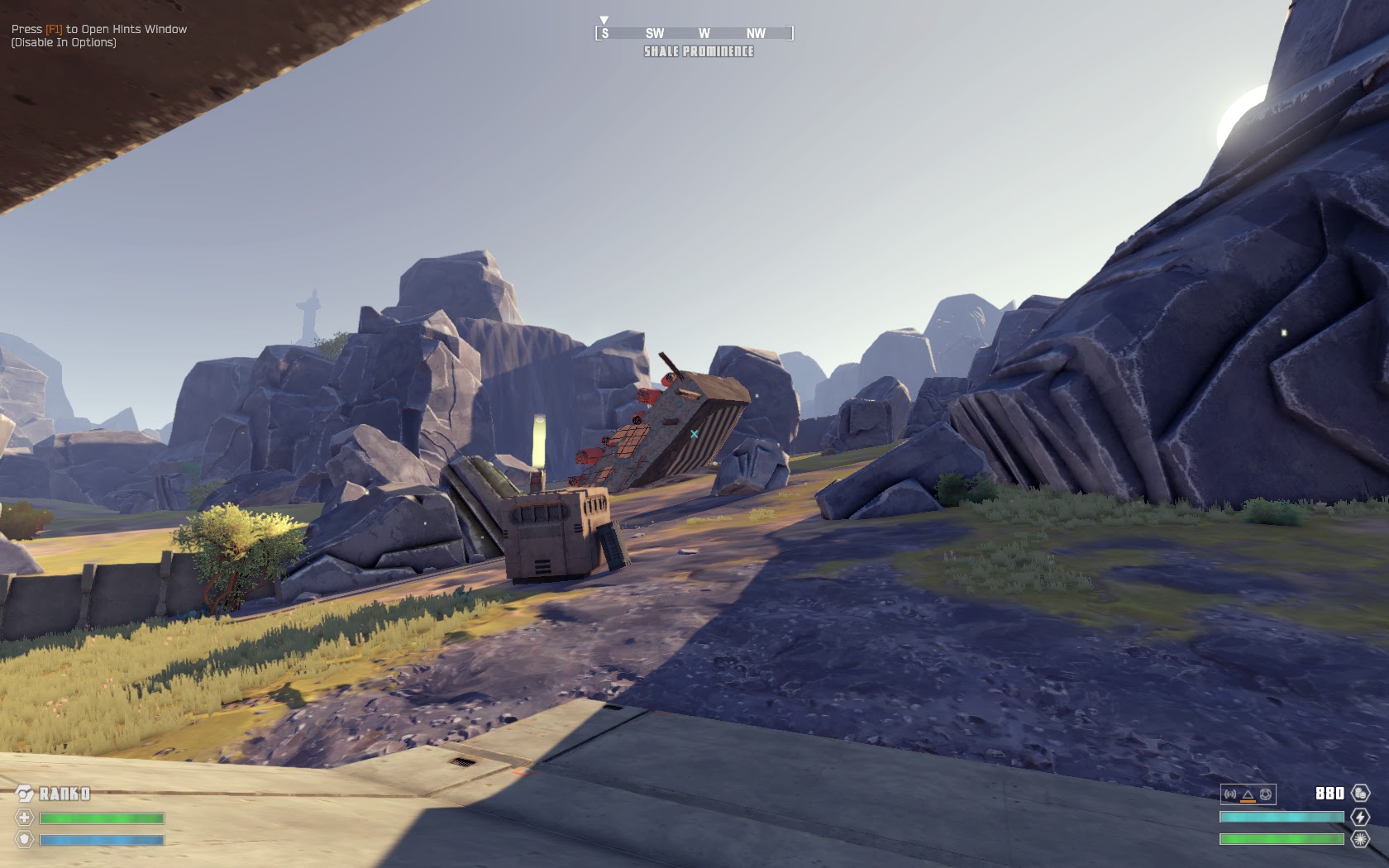
Tölva is a curious planet - basically void of any animal life except the occasional flock of birds (?) in the sky. As previously mentioned, other than other robots there is literally nothing to interact with. I guess this is kind of what the Mars Rovers must feel like. Visually it ranges from thought-provoking to dreary. While it's pretty to look at, it's also very repetitive. And frustrating. The planet is covered with derelict ships, probes, robots, bunkers, ships flying overhead... you name it. All these beg to be explored, there is the potential to an interesting story here. But the secret about what is going on is a tightly kept one. So you keep on moving around, destroying enemy robots and scanning things - hoping to uncover something that will make it worth your time.

Roughly six hours into the game it's difficult for me to recommend it. Some half-interesting gameplay elements aren't enough to keep me motivated when the story offers so little. On the other hand maybe there is something to be said for a straight-forward, predictable game that doesn't try to be more than the sum of its parts. At least it won't stress you out.

Thursday, October 25, 2018

Four Last Things (PC) - Review

More heaven than hell.


In the infinity of things it was probably inevitable that someone would take a closer look at renaissance paintings and think to themselves "hey, these are pretty whacky. Wouldn't it be fun to make a point & click adventure game set entirely in these paintings?". That someone is Joe Richardson and that game is Four Last Things. It is exactly the kind of thing I would use as an example of something that is either a stroke of genius or completely bonkers - but Joe Richardson wasn't the only one who thought it was a good idea, as Four Last Things is a Kickstarter-backed game. Let me say this though - it is a good idea.

I can't say I know much about art, or that I am overly interested either. I listen to an art podcast however so I guess that puts me slightly above average in interest-level even though it's more because of my massive interest in everything history and less about art specifically. In the end it really doesn't matter if you know or don't know anything about renaissance art when you play this game. If anything, if you go into this purely because of your love for point & click adventure games, you are likely to come out of it with a curiosity of renaissance art. Because boy are they weird.
Richardson seems to have been especially inspired by the works of Hieronymus Bosch (Four Last Things refers to a work by him), and it's not hard to see why. Just look up pretty much any of his artwork and you'll probably find a painting worth poring over for quite some time. Unless you know all the intricacies of renaissance symbolism, chances are they are going to make absolutely no sense.

Your guess is as good as mine.

The game itself is not big, it only contains around two dozen different screens to interact with. Each screen is a patchwork quilt of paintings, with certain parts simplistically animated. Richardson has clearly realized how absurd the whole idea is, because this game does not take itself seriously. If you're worried a game about renaissance art is too high-brow to be fun, you can stop worrying right now. The wikipage says PC Gamer called it "Monty Python"-esque and that is definitely a very fitting description. The writing is surprisingly fun throughout and probably the games biggest strength.

The story is simple but effective - you play as a character who has come to the church of Heavenly Peter, seeking absolution for having committed the seven deadly sins. The bishops tell you that the sins were done outside of their jurisdiction and so you need to re-commit them in order to be absolved in their church. Re-committing these sins is the entire game, meaning it is not very big, because we all know sinning isn't something that requires much effort. I finished it in 1,5 hours, admittedly I required some help for some of the puzzles meaning that if I had had the patience to try and solve them on my own the game would've probably lasted around twice as long.

That is not to say the puzzles are particularly difficult or unfair, on the contrary - I found the puzzles some of the most well-balanced I've encountered in a point & click adventure in a long time. Even though I am a bit too slow-witted to figure them all out, you are definitely given the right type and the right amount of clues to figure out most of them without having to make big leaps in logical thinking, especially if you're accustomed to a point & click-think. While they range from silly simple (and this is also pointed out in the game) to trickier several-step puzzles, you won't find any red herrings here. I wouldn't have been able to figure out the riddle in a million years though.

Looks overwhelming at first, just like good renaissance art should.

Each screen is accompanied with its own classical renaissance-tune, played by some character or characters in the screen. Each tune is mostly just a short jingle on a loop and I can understand why Richardson thought there needed to be a lot of variation, because every single tune wears on your ears pretty quickly. Fortunately you don't spend enough time in each screen nor with the game to become too annoyed by it (big ear-worm warning here though).

You control your character by  (surprise surprise) clicking on objects in the surrounding that are interactable, this gives you an action-wheel a la Full Throttle to either use (hand), talk (mouth) or look (eye) at or with something. Your items are handled in a drop-down menu. This works very well but you will find yourself with little reason to look at things (other to hear the witty description of it) and you won't pick up and handle many items. Most of the game is solved by talking to people. Unlike with some other P&C games I never struggled to find what objects were interactable nor where I could go next. I did encounter a bug of some sort where I wasn't able to interact with anything in the screen. Right-clicking makes your character do a somersault (to no apparent use in the game as far as I could tell) and only after doing that did the controls work again. I have no idea if this is working as intended, but it only happened twice and was barely an inconvenience.

In the end the Four Last Things comes out as something I am glad I have spent some time with. It's entertaining, and dare I say maybe even a bit educating. If you're into odd video games, renaissance art and/or point & click adventure games you could do worse than to spend a few hours with Four Last Things. It doesn't have much, but what is there is unconventional, witty and well-designed. And there is something to rewarding an oddball idea such as this one with your time and money.