Showing posts with label 2018. Show all posts

Thursday, July 24, 2025

Katamari Damacy REROLL (2018) - Review

The Katamari Damacy series has always existed in my mind as the best kind of video game that I never intended to play. It would've probably stayed that way if my then 5 yo son hadn't seen it somewhere and loved the concept. I decided I would get it so we could play it together. So I did get it, but we ended up playing something else together instead.

Katamari Damacy stayed in my game log untouched until I had one of those days when you go "Eh, why the heck not" with a shoulder shrug. It's not that I don't like the idea of Katamari Damacy, like mentioned I think it seemed like a brilliant game concept. Make a huge ball out of random stuff just because? You couldn't make a movie or book out of that, that idea could only exist in a video game.

The game was originally released on Playstation 2 in 2004, but as you can see I am playing the Reroll release from 2018. As far as I read up on it is about the same as the original but with updated graphics, but if you happen to be curious to know more details there is a great video on Youtube about it.


You have probably heard of Katamari Damacy before but if you haven't, you read that right - the core concept of game play is to make a huge ball of random things lying around on the ground. You play as the little prince who has to clean up the mess his father, the almighty King of All Cosmos, has made when he accidentally destroys all the stars in the sky. Apparently, balls made of random stuff can substitute for stars in the sky if you don't think too hard about it. 

And really, you could make up any excuse here because why wouldn't you want to roll things up into balls anyway? It's just plain fun, that's why, you don't need another reason. Each level comes with a minimum ball-size requirement and a time limit. Rolling things into balls isn't as easy as it first might seem. You can't just grab any old thing immediately, for things to stick to your ball they have to be smaller than your ball. Larger things will at best make you bounce off, at worst make things fall off your ball. So you have to be smart about how you go around collecting things, trying to avoid the things you can't pick up just yet and get back to them later. There is definitely a kick to get from finding a good path through the random items (they are very random and can even include living things like cats and dogs) and a high level of annoyance when you screech to a halt from something that you can't pick up yet. 


As your ball grows the area you're in will grow, revealing more items for you to pick up. Everything that attaches itself to your ball makes a satisfying ploppy, bloppy and shwoppy sound, for lack of better description. And let's talk a little bit about the music. It is great. From the intro song to the stage themes, each tune fits perfectly and makes it a joy to fail, because fail you will.


The game is a joy to look at as well, and the items scattered around are clearly organized in a way to entice you to move around the levels in certain ways. I want to mention it again here that the items you get to pick up can really be just about anything, but every now and then you get special stages where the Almighty King wants you to create a ball made up of some certain item - swans for instance. It all makes perfect sense when you play the game. I'm kidding, it doesn't, but rolling a ball of flapping swans around is equal parts hilarious and disturbing.

Knowledge of the places you go around in seems crucial to be able to make the time limit because despite the games best intentions to give you control and overview, it fails somewhat on that.

The game designers have really tried to think hard and clever when designing the controls, realizing that a game like this above all requires this to work well. To wrestle your ball around you have to use both control sticks, which allows you to get more control over things like speed and turning - absolutely essential to be able to cut corners and avoiding rats that are trying to ruin your ball. (On the keyboard it is a double-WASD setup, using JIKL as the other "stick", and I actually had more success with playing it this way).

Shoulder buttons allow you to get an overview but for all the good things they've thought of I can't help but feel like they've missed a huge point - how to control the camera. This problem becomes very frustrating when you try to get your ball the way you want it to, but you can't even see what is around you. The overview button, which gets your character to jump up in the air, doesn't solve this issue at all. As I wrestle the control sticks I literally feel like I am rolling a big ball of garbage in front of my face, and plus points for realism I guess. Unfortunately it takes a lot of the fun out trying to doing a good job when you feel like you are constantly being resisted. The ball at times doesn't feel cooperative in the slightest, making any bumps and knocks you take a lot more frustrating than they should be, as you see your hard worked bits fly all over the place.


The timer continues to tick down as you find yourself stuck in a corner, or trying to get up a tiny ledge, and it takes way too many precious seconds to try to find a way to move forward. There is a lack of control and cooperation that feels unforgivable for a game like this, despite what seems like their very best efforts to avoid these problems.

Maybe I am just getting old and slow, I am noticing I have a hard time taking good turns in Mario Kart 8 as well... But whatever the reason, and however much I think Katamari Damacy in many ways can stand as the perfect example of something that a video game can do that other media can't, I end up struggling too much to have fun. And yet, when I am not playing it I find myself thinking it would be nice to load it up to roll some more balls. There is something about it that is simultaneously relaxing and frustrating. It seems I am not the only one who thinks this way, the comment section on the OST on Youtube is full with similar sentiments like "Katamari Damacy is the most infuriating, frustrating, stressful, stress-reducing, enjoyable, satisfying, joyous game ever made" and "the katamari franchise is simultaneously the least stressful and the most UNGODLY STRESSFUL game i've ever played.",

I've decided to uninstall it several times, but I haven't. I am having more success when I am not trying to use a controller, so maybe Katamari will get to stick around a while longer still... there is just something appealing to the idea of rolling up garbage.

There is a two-player mode that works quite well since there can be some fun to be had from sharing the pain of trying to build the bigger ball. You can even roll each other up if you manage to get that much bigger than the competition. For all the frustrations I still want to recommend checking it out, if nothing else than to experience something truly unique. And then I am going to do something as horrible as recommending a mobile game if you want a better version of this style of gameplay. Check out the Tasty Planet series - it's fun.

Sunday, December 3, 2023

Moonlighter (PC, 2018)

 I've played a fair bunch of roguelites and even at their worst they always offer a few hours of fun. At best they manage to find exactly the right balance between challenge and "just another go" to keep you hooked for hours. So which one is Moonlighter? 

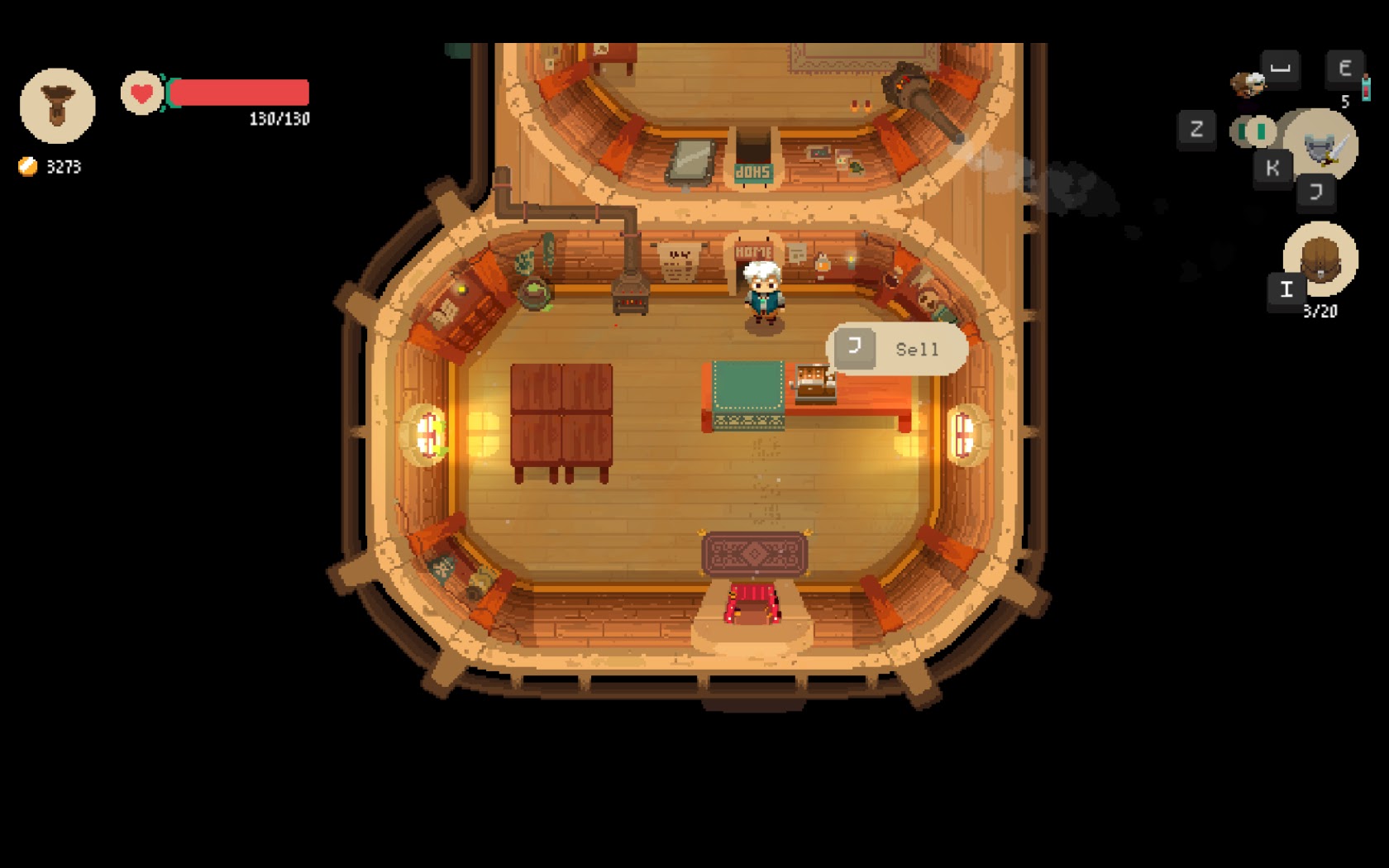
Moonlighter is a roguelite with a pretty straightforward concept - go into dungeons, get loot, sell loot, improve gear, go into more dungeons and get more loot. It's a loop that we're all familiar with at this point. The tiny twist to Moonlighter is that instead of selling your loot to some store, you are the store, selling your loot to other people.


It's a minor difference, but it's a fun idea. You own a store that you can improve in different ways, allowing you to make more money off the stuff you have pried from dead monsters in the dungeons. With the money you can also invest in your hometown - purely for your benefit of course. This is how you get access to a potion-maker and a blacksmith for instance.

You decide what to charge for your items, but the people who come into your store aren't willing to pay just anything for your stuff. There is a sweet spot where the buyer thinks it's worth it and you think you're getting enough. The game gives you a well designed system for keeping track of what different items are worth. It also helps you keep track off items you might want to keep to use for potions or gear for yourself.

The dungeons are comprised of rooms spread over three levels with a final boss at the end. While the dungeons are randomized in layout, they all contain at least one pool that restores your life, and an abandoned campsite of unknown purpose. The dungeons, at least as far as I have gotten (five or six levels down) aren't overly difficult, as long as you keep your focus and learn how the different enemies work. The enemies themselves are mostly bibs and bobs of this and that - meaning they don't really look like anything other than pieces of rocks, slime and sticks put together. Disclaimer here though, I haven't seen everything yet, but the enemies do repeat in style and for the first two dungeons they are mostly the same.

You find these tents, but they serve no purpose. Just like real tents.

There are clever systems that allow you to get in and out of the dungeons. If you die you lose everything you've collected in your bag, but this means you get to always keep your gear and stuff that you have in your 5-slot special bag. To get out of the dungeon you have to pay money and there is a system that allows you to vendor items inside the dungeon, but to a lesser price than you would've gotten for it in your store. As you progress through the game you get more options with how to deal with your items and how to get in and out of the dungeons that I thought were well thought through.

The graphics are endearing neo-pixel style, the music is unobtrusively mellow even in the most heated battles - definitely nothing that will neither stress you nor get your blood pumping here.

Curiously, for a game that overall has a lot of smart design choices, the game is not playable with a mouse on PC. It took me a lot of web browsing and reading of angry and frustrated forum posts before I understood this. Instead you have to control your character with WASD as typical, but also with IJKL. I can honestly say, I have not played a game from after 1990 that has required me to control anything with IJKL.

Why am I fighting this guy? I don't know.

I will say however that I don't understand the hate towards this. As soon as you understand that this is how you do it, it works perfectly fine. I never missed my mouse or thought I failed a run because I didn't have it.

As mentioned the challenge for any roguelite is to make people want to go "just one more run" - there needs to be something that keeps that feedback loop going. The best games (a lot coming out of the Blizzard studios for instance) do this to the point where it's almost addictive. Worst case the player feels what they are doing is pointless.

Moonlighter has a lot going for it, with smart systems for handling items and a lot to tinker with and upgrade, a well balanced difficulty and a little twist to make it a bit more unique - basically all the ingredients of a great roguelite. But after ~10 hours played I definitely feel like something is missing. It doesn't take me long to figure out what it is. I am missing a story.

You start off small, but with big dreams.

The game starts out with a short introduction to the concept of the dungeons and gets you wondering if there is something more to explore in there besides finding loot. In the dungeons you find scraps of paper and some times corpses left from other explorers that have come before you. They talk about (the papers I mean, not the bodies) the mystery of the dungeons and why they keep changing. But this never evolves into anything, you quickly notice that the pieces of paper are more for show than to continue a story. The people of the town don't have any personality either and don't interact with you in any other way than to do business. I am curious, I want to know more!

There is lost potential here, but maybe the developers were worried that people aren't interested in this kind of gameplay anymore and put their focus on a well designed dungeon crawler instead. There is sense in that, but to me it makes the game feel empty and repetitive pretty quickly. While some of this might come later in the game and I just haven't seen it yet, I see a discrepancy between the nice flow of improvement in game systems and complete lack of story development.

Moonlighter reminds me so much of a game on the Playstation called Azure Dreams. Your character goes into a monster tower to find items, to gain money to improve their home town in different ways. More crucially however, there is a lot of interaction between you and the other people of the town and in true mid-90s fashion you can get into romantic relationships with some of them, There is also the mystery of the final floor of the tower that constantly beckons you to try to get higher. In Moonlighter that enthusiasm quickly wanes when you get the feeling of "oh, was this it?". Even Steamworld Dig, another great game with a similar concept, made me feel like every dig was important.

To be fair to Moonlighter, I haven't played Azure Dreams for 20 years and maybe I would feel differently about it now. Maybe I am simply too old for games that just make me do things for no other reason than doing them. But if you are after an otherwise well designed dungeon crawler that lets your obsess over loot, you could definitely go worse than this game.

Monday, January 28, 2019

Return of the Obra Dinn (PC) - Review

A Fantastic Voyage
Definitely spoilers!

Some games have great gameplay, some games have great stories. Some games are memorable just because of their unique and/or peculiar premise. And some games have all of that. Return of the Obra Dinn is such a game.


How do you even begin to describe it? Someone used the phrase "murder-sudoku" and I find it fits so well I am stealing it. So the long version is that Return of the Obra Dinn (ROD) is about you finding out what happened on the boat Obra Dinn, as it sails into port with no one aboard. Officially your reason for doing this is to pay out insurance claims, but really you're just curious about what macabre finds the ship holds. You find some bodies on board, but without your magical pocket watch that allows you to see the final moments of whatever dead person you find, you wouldn't be able to guess what actually went down on the Obra Dinn. The ship started out with a manifest of 60 people, and the goal is to figure out what happened to all of them. The game only gives you clear advice on a dozen or so of the fates, the rest need to be surmised and in the end even straight up guessed. Not only do you have to figure out what happened to each person, but also who they are and who did it to them (when applicable, not everyone is murdered).

Short version, it's like Clue but with 60 people instead of one. Or like I said, murder-sudoku. Because as you travel through the ship and find out about different fates, you slowly realize where people must've been and when. It's a pretty ingenious idea and it's executed very well.

Clue, not just a good board game but also an entertaining movie

The game is designed by Lucas Pope of Papers, Please fame - a game I have not tried but that I definitely have a lot more interest for now. When I was reading about that and all I understood about it was that "you're a clerk handling immigration papers" it didn't exactly strike me as particularly thrilling. The great reviews told me that I was probably wrong, and in the end my main reason for not playing it was the tragic subject matter. Either way, it seems like Pope has an eerie knack for turning what sounds like a bit of a lackluster premise into a highly entertaining and thought-provoking game.

Not only is ROD a fun game to play, it's permeated by some really clever design choices that of course add to the overall impression.

For instance, graphically it is very simplistic, using something apparently called "1-bit graphics" that really have to be experienced to fully appreciate. Think old Mac games like Shuffle Puck Café and you've got a good idea. By using your magical pocket watch in places where someone has died, you can see the fate of that person. Each fate is presented by a black screen and sounds - often talking, some times just effects - and then a freeze-screen of the moment of death in which you can move and look around. This means nothing (or at least not anything I remember) is actually animated in the entire game, and yet stays very effectful and informative. If you think this sounds dull, when playing it you quickly realize that any other way would've detracted from the experience. This is the best way to tell this story. By just getting these snippets of clues (sound, an image of death) you're given just barely enough to figure out what is going on in each instance.

Never got past the second guy.

The game then allows you to fill out the information in a book you're carrying - who was this person, what happened to them and who did it to them? With 60 people to choose from and a plethora of ways to die to choose from, it is no easy task. The game will tell you when you're right only when you've got three fates correct at the same time, so just randomly guessing won't get you very far in the beginning (but might be necessary towards the last fates).

The sound effects are a big part of what drives the game, both gameplay wise and in terms of quality. It definitely helps if you have general knowledge of things like accents and boat terminology, because they will help you a lot in determining who people are. It's such a great feeling when you can figure out that a certain person has to be the Swede because he says something in Swedish. Pope is kind enough to include a glossary for the most common terms, and it's useful because I had never heard of a "bosun" before. Of course this game will also fuel your prejudices as you try to find the "Indian looking guy" based on an Indian sounding name in the ship crew manifest.

The game also unfolds in a good pace and you will never wonder where you need to go next. Only once did I get stuck because I am an idiot who thought I had opened every door, but hadn't. While the fates start out with some pretty ordinary murdery stuff, as you travel further down the decks you will find that the Obra Dinn and its crew has been through some pretty zany stuff. There were many times when I went "what the..." and for the longest time I thought Pope was almost comically exaggerating, but it all wraps up to mostly make sense in the end. This is a game best played going in blind because once you know what happens a lot of the fun factor is taken out of it.

There are several colour palettes to choose from if black and white don't do it for you.

So is this game entirely without flaws? No, there was one thing I had some trouble with. While guessing who everyone was in the ship manifest was a great and well balanced challenge, trying to figure out what exactly happened to them was sometimes just impossible. How do you distinguish between a strangling or a beheading (it might seem obvious, but isn't always)? How do you know if someone was "knifed" or "cut with a sword". How do I know if someone was drowned by a beast or just drowned? Was someone crushed by the cargo or the rigging that held the cargo?

This is my only, minor, issue I had with the game though. Everything else is so well designed it is pure joy to play through. When the game told me to wrap up (as it will) I almost said "Awww, I don't wanna" out loudly. Not because the game feels too short, but because you want to spend more time with it.

I managed to figure out 36 fates entirely on my own and roughly another 10-15 people without their cause of death. The rest I had to use a guide for and there is definitely reason to try to get all the fates correct as I found out. If you don't, you get what I would call the "bad ending" that doesn't allow you to see the entire story of the ship. As mentioned you'll get clues for the vast majority, some clues are basically give-aways and some are extremely subtle. The last couple of ones have to be guessed based on deduction. Anyone who manages to figure it all out by themselves are frakkin' Sherlock Holmes' in my book.

Return of the Obra Dinn is one of those games that just does everything right (my minor issue seriously barely worth mentioning). It will entertain you, it will make you think and it will almost certainly give you an experience that you haven't quite had before. Just like when you find a really good book or movie, it'll leave you with a feeling of happiness over having done something that was genuinely fun and so worthwhile.