2023 is at an end and it is time to look back at the year that has been and summarize - what was good and what was bad? Any New Years resolutions to break?
I try to keep track of the games I play, but I am very bad at it. Because of this I unfortunately can't make a good list of my favorite games this year. I also don't really play enough of them to make a list of best ones, I guess. I recall replaying FFVII and that was just as great as I remembered, which I was relieved to experience as I had worried my rose-tinted goggles might've been at work. No, that game still holds up 100% and I had an absolute blast playing through it again. Other than that it has mostly been World of Warcraft: Wrath of the Lich King Classic and me trying to squeeze in other games, and some blogging, in-between.
My personal year has been good, other than my washing machine breaking down and me having to wash our clothes at my work for the two weeks we waited for a new one to arrive. But it is here now and it is doing what it should, so that problem is solved.
Best Books of 2023
These are by no means new books or released anywhere near 2023, but simply books I've read during the year. I read about 50 books, if you count the Judge Dredd Collection of series, which I do. Here were some of my favorites;
1. Judge Dredd - The Complete Case Files
A collection of every Judge Dredd series released in the 2000AD magazine and they are all amazing. I love reading them and I am happy there are many more for me to get. I am at the 7th book when writing this and I think they've released 42 or so. I tried thinking of some favorites, but I actually really enjoy them all - big stories and small ones alike. I'd love to explain the concept, but it needs to be experienced to be fully understood. In essence, Judge Dredd is a supercop in the future, handling all kinds of extremely crazy future problems. The tone is satirical, dark and far-out imaginative. I'm endlessly impressed by the writers abilities to come up with more and more crazy stories.
2. The City of the Chasch by Jack Vance
Not an amazing book by any means, and maybe I just liked it because I was so positively surprised that it wasn't as bad as I expected. Some time ago I acquired a haul of old sci-fi "classics" released in Sweden, in bad Swedish translations, under the Delta Science Fiction name. Most of these books have been a chore to get through. Out of the 30 or so I've read so far, maybe two or three have been worth reading. The City of the Chasch was one of them. The main character Adam Reith is sent out from Earth to investigate a distress signal on a planet called Tschai. After a crash landing he find that the planet is inhabited by loads of sentient species, many of which keep what seems to be humans as slaves. The humans themselves don't remember being from anywhere else, neither seems anyone else. Are these humans actually from Earth? The book has good world building and an interesting mystery at its core, it kept me entertained throughout but is part of a series so I haven't read the conclusion yet.
3. The Three Musketeers by Alexandre Dumas
The Count of Monte Cristo is my favorite book ever. Of course I had to see if Alexandre Dumas could pull it off again. And he does. The Three Musketeers is also an amazing, fun and exhilarating read and none of the movies I have seen do it any justice (which is also true for The Count of Monte Cristo). The story of how the young adventurer d'Artagnan befriends the musketeers Athos, Porthos and Aramis (not their real names by the way) has everything you want in a good book.
This year I read Game Boy: The Art Collection and The Secret History of Mac Gaming. I already own two or three other books from these publishers. If you're into video games, nostalgia, well written facts and pretty pictures, these books provide and then some. The quality and design is superb and the books themselves are almost works of art. It helps that the content is great too. Definitely check them out, they're worth every penny.
Best Watched in 2023
I don't watch many tv-series, but I've seen a fair few movies. Here were some standouts;
1. TMNT: Mutant Mayhem
I enjoyed Rise of the Teenage Mutant Ninja Turtles: The Movie, without having watched any of the TV-series. So I decided to give Mutant Mayhem a chance too. I loved the quirky animation style, I loved the characters. The humour was spot on TMNT. Very entertaining and worth checking out if you're into TMNT.
2. Violent Night
A friend of mine recommended Violent Night, probably knowing what kind of action I am into. And this movie delivers. It's such a whacky concept that it takes all the way, and it even works better than Tommy Wirkola's previous movie Dead Snow, which was also fun. I love John Leguizamo in anything, yes even Mario Bros and Spawn, and he is great here (so is Beverly D'Angelo is a badass matron). But of course the real hero is David Harbour as Santa, and the writing.
3. Indiana Jones and the Dial of Destiny.
I don't care what anyone says, I think this movie was absolutely great. I watched it with my kid in the cinema and had good old matinee fun! Because this was the first Indy movie he saw, we of course had to go back and watch all the other ones too. It was fun to see him recognize characters from the earlier movies and Dial of Destiny is a worthy successor. I like it better than Temple of Doom and Kingdom of the Crystal Skull.
4. Lightyear
I hadn't watched this yet and because I have been disappointed with most Disney outings since Toy Story 4 my expectations were low for this movie. It wasn't improved by the fact that reception was bad as well. I was very pleasantly surprised then to find a really neat sci-fi movie in Lightyear, and probably one of Disney's best movies in years (I also quite liked Onward). It gave me some hope for Disney, but watching "Wish" later this year squashed a lot of that...
What were your standout experiences in entertainment this year? I am always up for good tips in the reading, watching and gaming department.
First Contact has always had a special place in my heart. I am pretty sure it was my first Star Trek movie and if I wasn't a Star Trek nerd before that, First Contact definitely made me into one. It had been a while since I last rewatched it and for some reason I noticed I seemed to be postponing it. Some part of me was worried (and still is) that I could never do it proper justice, but another part of me also worried that maybe my tastes had changed and I wouldn't enjoy it so much anymore.
Well, let's just say that the latter definitely didn't turn out to be an issue. When the credits started rolling I was literally thinking to myself "this movie is damn near perfect". So yeah, this movie is damn near perfect and the following review is basically just going to be me explaining to you why I think so.
As an anecdote, I find that First Contact has many similarities to the James Bond movie Golden Eye. It too was the first movie with a new lead and they're both absolutely amazing. But then something happens and the remaining movies with that cast are just nowhere near as good (still highly entertaining though).
I'm going to try to lay out the general idea I have for why this movie works so well before I go into details about the actual story;
First Contact, knowingly or unknowingly, borrows some of the winning concepts from earlier Star Trek movies. Firstly it continues a fan favorite arc from the TV-series (just like Star Trek II: Wrath of Khan), namely the Locutus arc where Jean-Luc Picard gets assimilated into the Borg collective. Just like Star Trek II, it sees the Star Trek crew revisiting one of the better antagonists in the series.
Secondly it uses another fan favorite in the time travelling concept. This allows the crew to revisit a past part of Earth just like in Star Trek IV: A Voyage Home. While this part of Earth isn't the exact same as our own, it is definitely a lot closer to us than to the future the TNG crew comes from and allows "us" to be part of the Star Trek universe in the same way that made Star Trek IV so interesting and fun to watch.
Other things this movie gets right;
The pacing is absolutely perfect. We get thrown into the heat of the story immediately and the movie keeps our interest throughout without just throwing things randomly at the screen. What happens constantly moves the story forward and we neither feel like scenes are needlessly added nor that we've missed out on vital information.
They've done the exact right choice when deciding what characters to focus on and how much space their character development should get in the story. First Contact focuses almost entirely on Picard and Data, arguably the only two interesting characters in TNG, but manages to squeeze in just enough of everyone in the rest of the crew that it doesn't seem like Picard and Data practically work alone (something the earlier Star Trek movies definitely struggle with).
By splitting the setting to "the crew on the ship" and "the crew on Earth" they manage to fill the movie with both one part that is humorous and one part that is tense and action-filled without these parts getting in the way of each other or feeling disjointed. Instead these parts run next to each other absolutely seamlessly and logically.
The movie starts with what could either be called one of the duller intro's I've ever seen or more optimistically described as an intro that doesn't try to wow you with silly effects. After a few minutes of names appearing over a blue smoke we see Picard having nightmares about the Borg. When an admiral Hayes contacts him he already knows that the Borg have come to Federation space to Borg everything up.
I could probably write a whole essay on what make the Borg such great enemies too.
I absolutely love the non-f*ckery about this. The movie starts and bam, we're literally right into the shit hitting the fan. The Borg are here to mess you up and everyone watching know what a big problem this is. Straight from the first minute we are fully invested and on our toes about how this is going to go down. Similarly to A Voyage Home it is fairly soon going to be apparent that all of this is only going to be an excuse to set up the time travelling part of the story, and this "back in our own time again" part of the story is never going to get resolved (within this run-time). After having watched it you might still have questions, but you'll be so satisfied with the self-contained part of the movie that you don't care.
Because Picard has been part of the collective the Starfleet doesn't really trust him around the Borg anymore and send him and the rest of Enterprise E to guard some sort of border with the Romulans. Everyone else in the crew agree that those orders are absolutely bonkers and to be fair it doesn't really make sense to leave one of the best ships in Starfleet out of what probably is one of the most defining fights of the Federation just because you don't trust the captain. Surely you would just remove the captain in that case and not the entire ship?
It doesn't take too long for Picard to say "screw this" and go to help the rest of the fleet. With his special inside-knowledge of the Borg (something you'd think Starfleet would've been keen on getting their hands on rather than sending him off to some border somewhere) he manages to unite what is left of the fleet to destroy the Borg cube that is threatening Earth. At this point it's not entirely clear why there is only one cube and where the rest of the Borgs are and that will never be explained later either (see point I made above). We get a short cameo of the Defiant from DS9, captained by Worf who moves onto the Enterprise when the Defiant is put out of use.
Unfortunately not.
A sphere breaks out of the exploding cube however and quickly moves towards Earth. The Enterprise goes into pursuit and the sphere disappears into a temporal rift into Earth's past. Enterprise is stuck in the temporal wake, manages to catch up to the sphere and destroy it, but not before it managed to fire off some shots towards the surface. Now they set out to find out what the sphere tried to do in this specific time period, which turns out to be 2063, very closely to the time and date of "first contact" ie when humans made their first faster-than-light-speed flight and caught the attention of some Vulcans who happened to be passing through our otherwise insignificant Solar System.
Apparently the Borgs had been trying to prevent this from happening because that would leave the humans in a completely different position in the future. Possibly, probably, there wouldn't be a Federation the way we know it at all. It's interesting to note however though, that since the Borg work under the principle of "adding your distinctiveness to our own", crippling and throwing the culture you're about to assimilate back hundreds of years technologically and scientifically seems like a counter-productive thing to do. The Borg are changing the humans so they'll be easier to assimilate, but in the process they're removing pretty much everything that made the humans worth assimilating in the first place (the fact that Borg don't bother with civilizations too underdeveloped has been established at this point afaik).
Picard takes Data and Crusher down with him to see what damage the Borg caused and this makes total sense - you bring the doctor for the wounded and the walking computer for the possibly damaged old-timey spaceship. While Crusher takes care of some wounded, Data and Picard move towards the missile silo where the rocket-gone-spaceship is being stored. Inside they are being shot at by an associate of Zefram Cochrane, but wait - I've forgotten to introduce Cochrane so far. Don't worry, I know you all know who he is and the movie doesn't make this mistake either. While the movie doesn't immediately tell us the significance of the "random" humans we get to see on the planet surface when the sphere attacks, it's quickly explained that one of them is none other than the inventor of faster than lightspeed-flight Zefram Cochrane.
Picard fails to assure the associate, named Lily, of their non-hostile intent and Data decides to take a different approach in a great scene. He jumps straight down some thirty meters and further confuses Lily when he is completely unharmed by her bullets. She faints and it turns out it was only partially because of shock, she's also suffered severe radiation poisoning and is taken onto the Enterprise by Crusher. This way the movie logically sets up and moves into the next part - the return of the Borg.
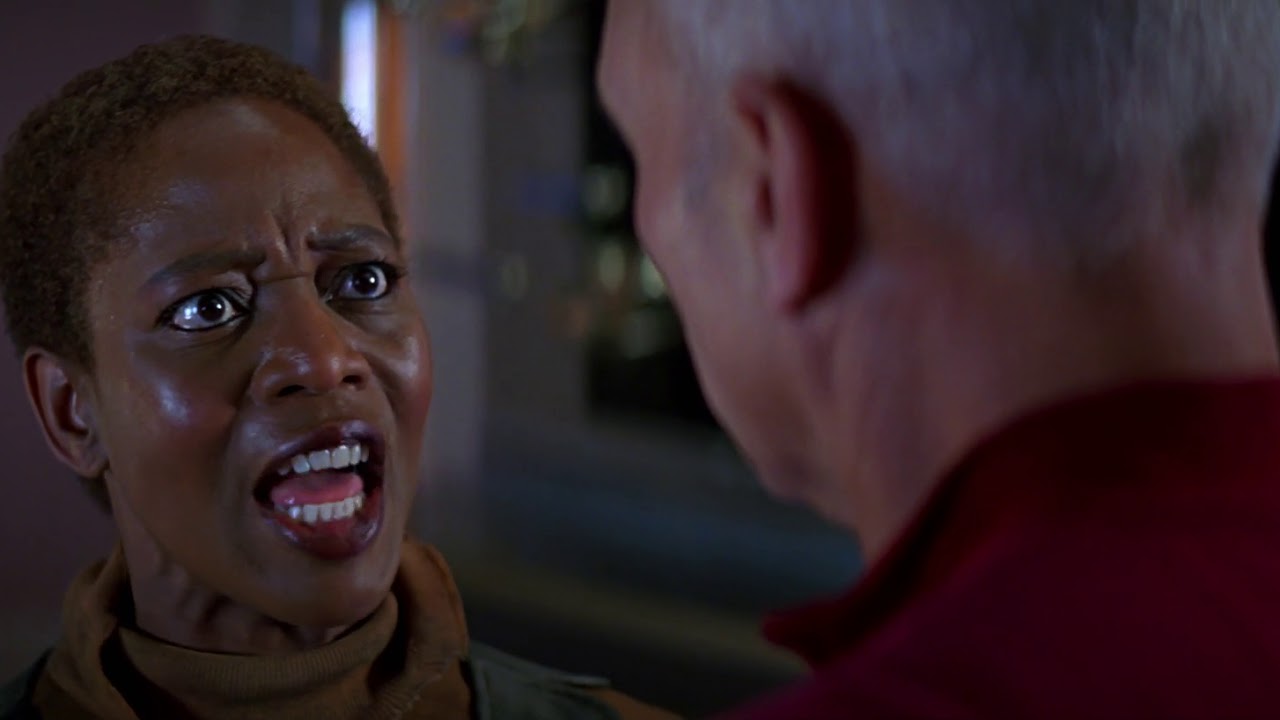
Lily (Alfre Woodard) - One of the better side-characters
On board the Enterprise some people have noticed that the climate control seems to be malfunctioning and the heat has slowly gone up. I wonder what that could be about!? Picard spider-senses (aka Borg-implant sense) that something is wrong and asks Worf if something is amiss onboard the ship. When he is notified about the changed temperature, he immediately decides to return to the ship while Riker, Troi and Laforge go down to the surface to oversee the repairs to the rocket and to find Cochrane who has gone missing.
We're about a third into the movie and now it smoothly transitions from what has so far been a fairly standard setup into the two-pronged story-line that I find truly makes this movie so well designed and fun to watch. On the one front we follow the crew on the surface who are trying to deal with an unwilling Cochrane, giving us a slower and more humorous pace. On the other front we get Picard and Data (and Lily) trying to deal with the Borg threat on the Enterprise, giving us suspense and action. The greatness is not just that the setup delivers on so many aspects of Star Trek, but that they harmonize so well together, running next to eachother throughout the remainder of the movie without detracting from eachother or confusing the viewer. I can't emphasize enough how well this works even though they are completely different in style, the crew on the surface have no idea what is going on aboard the Enterprise until the very end. Both the writing and the editing is absolutely superb here.
Like I mentioned the focus in First Contact is definitely on Data and Picard, and I don't mind because I find most of the rest of the crew to be walking blocks of wood with one character trait attached to them. It is credit to this movie then that what little we do get to see of the other crew really works for them. Why couldn't the writing have been this interesting for the TNG series? Troi manages to find Cochrane who, off-screen, gets her to drink a lot of drinks. When Riker finds them both they are listening to much too loud music and Troi is drunk. It's a fun scene that Marina Sirtis pulls off greatly. When they decide to tell the truth to Cochrane he responds with "You people are all astronauts on some kind of... star trek?". Lovely.
Zefram (James Cromwell) is well played too.
Oh, and I haven't said anything about it yet but the effects are really cool in this movie. They're so good in fact I've written the comment "cool effects" twice in my notes. One of the best ones, though I am jumping ahead of myself a bit here, is when the Borg Queen torso gets attached to the rest of her body, it looks practically flawless. For a movie from 1996 it looks exceptional.
So speaking of Borg then, back on the Enterprise it seems like the Borg managed to beam themselves off the sphere and onto the Enterprise just before it was destroyed. They've made themselves comfortable on deck 16 and are, as they're known to do, slowly assimilating their way through the crew. After some running around and losing track of each other, Picard ends up with Lily and Data ends up with the Borg Queen. One of my favorite scenes in the entire movie is when Picard tries to explain the situation to Lily who not only has no knowledge of the Borg but also has to quickly get accustomed to the fact that she is running around on a starship from the future. She exclaims "Borg? Sounds Swedish.". Then as they run into the Borg she corrects herself, "definitely not Swedish!". To me as a Swede this joke really hit home and I remember the entire movie theater bursting out laughing.
Data also gets a lot of good scenes with the Borg Queen, who seems fascinated by him. The emotion chip that Data implants in the previous movie gets a lot of use here as the Borg Queen grafts skin onto Data to let him feel both pleasure and pain. Sexy stuff is sort of insinuated, they definitely share a kiss, and overall their shared screen time together is great. They're so different, yet so similar (both being semi-humans seeking perfection in their own ways), and that is pretty much what the Borg Queen seems to think as well. Yet again everything is superbly delivered by Brent Spiner and Alice Krige who play Data and the Borg Queen respectively. She uses the emotion chip to break down Data's will, or at least so she thinks. But I am getting ahead of myself again.
How un-Borg. But what is Borg anyway? I have so many questions!
Picard finds out that the Borg are trying to rebuild the deflector dish into a subspace transponder, allowing them to hail the Borg of that time (though they are still in the Delta Quadrant) to come to Earth and mess things up. Cue another great scene where Picard, Worf and random red-shirt person who will die, gear up to go onto the outside of the ship to see if they can throw a spanner in the Borg works. They do it by literally removing the entire deflector dish from the ship, and the scene where the Borg, still working on the dish like nothing has happened, slowly float out into space is just brilliant and hilarious. There is a great attention to detail all over this movie too - when they put down their weapons at one point in the scene you can hear the click when the weapons magnetize on the hull, explaining why they don't just float out into space. The soundscape when they walk out onto the hull reminded me a lot of TMP too, which is a big plus in my book.
Speaking of weapons and the Borg though, there is something that doesn't really make sense in this movie. It's been well established at this point that the Borg adapt to any kind of energy weapons once they've taken a couple of shots. Throughout the movie we see how Worf tells Picard that he's remodulated the weapons to allow them to get a couple of more shots off. Then every now and then we get to see some hand to hand combat, and a scene where Picard shoots down some Borg in the holo-deck with some holo-bullets (which should count as energy weapons really). Overall it's portraid like the regular weapons aren't very useful and physical weapons work a lot better. So why not always use them? Equip everyone with a Bat'leth or a Magnum pistol and suddenly the Borg will have a lot harder time adapting, I'm sure. Maybe this is explained somewhere in the Star Trek lore, but it's not explained in this movie.
Back on Earth Cochrane is starting to feel that the whole thing is getting all too much. Laforge tells him about Universities named after him, statues raised for him and so on. Cochrane admits later on that he only did any of this for the money (and naked ladies that would come with the money) in a scene that adds a lot to the Cochrane character. Overall they've managed to make all the characters feel a lot more real and human than they generally do in TNG, something that series really struggles with if you ask me. All the main characters in the movie get their own little character development scene where we get to see that they are multi-faceted and not perfect. I've mentioned Cochrane's and I'll get to Data's.
Worf suggests to Picard that they destroy the Enterprise and that way they'll get rid of all the Borg in one hit. Picard refuses and calls Worf a coward for trying to end the Borg battle the easy way. Worf is, understandably and understatingly, not amused but since the captain has said no, no one continues to question him even though they all agree that he is wrong. No one except Lily, remember her? The associate from Earth who found herself on the future starship infested with cyborg-alien. She straight up calls Picard "Captain Ahab" and after some back and forth shouting Picard gets the hint. He is taking things too personally. It's a great and believable scene, especially if you have seen the underlying story arc from the TV series.
She ain't sugarcoating it.
Picard starts the self-destruct sequence and in the meantime another countdown has started down on Earth - the rocket is ready to launch and make itself known to the Vulcans. These two plotlines have been running parallell to each other and now they're about to fuse together again, seamlessly. But it's not over yet. Picard realizes that Data is in trouble and sets out to save him. The Borg Queen realizes that the rocket is about to do a fly by and decides to shoot it down. The stakes are still high as we move into the final act.
Picard comes upon the Borg Queen in the engine room, where all the scenes between her and Data have taken place as well. Picard offers himself in exchange for Data to allow Data to escape while Picard keeps the Queen busy during the counting down for self-destruct (silently), but it seems like Data has already been converted to the Borg Queen's cause as he goes to set off some torpedoes aimed at the rocket that Laforge, Riker and Cochrane are in. They meanwhile have no idea that they are about to be blown out of the sky. They think the Enterprise have moved in closer to give them a send-off, as they still don't know about the Borg on board.
The shots are fired, everyone is holding their breath... and they miss. Data has tricked the Borg Queen into believing he was now on her side, instead he breaks open a couple of plasma conduits (something that was hinted at earlier in the movie) and as the plasma pours out onto the floor Picard and Borg Queen try to flee onto higher ground. The Borg Queen clings onto Picard when Data emerges from the plasma clouds and pulls the Queen down. Her organic compounds become destroyed, destroying her in the process. It's another great scene showcasing some really well made special effects. Data, who has had human skin grafted onto his arm and face now looks like something out of Terminator. And all that is left of the Borg Queen once the plasma has been vented is a twitching metal skull with spine. It's exactly the climax and finale this movie deserved and it is so well done. (And then Picard runs back to cancel self-destruct, of course).
Maybe this is the evolution of the T800?
Then we get the finale of the other storyline as well and it is equally good. We get two great finales in this movie! Cochranes FTL rocket has gotten the attention of the Vulcans and they land on Earth to speak to him. This is First Contact. It happens in 2063. I could possibly be alive then (I'd be 78). This point, while suitably low in tone in the movie, holds so much weight and significance to us as viewers and fans because it started everything. From this point on we've followed so much of what this fictional humanity becomes, and we've loved (almost) every second of it. I starts right there in that scene. Watching it is just so... cool.
But… the germs? How do they talk without translators? So many questions!
And that pretty much sums up this movie. It's cool. It makes the right choices, from the start and all the way throughout. When I was 11 or whatever, watching it for the first time in the cinema I was absolutely awe-struck by how entertaining this movie was. Now that I am *ahem* somewhat older and have watched it a couple of times more, I can really revel in all the details that come together to make this movie so... dang... good. It might not be perfect in the sense that it has some plot holes and leaves some questions open (like what happened to the Borg invasion back in their own time?) - but just like A Voyage Home you don't notice, and if you do you don't care, because the things that matter are the things that work. It makes sense, it looks cool, it is action, it is funny and it is everything that is great about Star Trek.
First Contact is probably my favorite Star Trek movie. I'll throw in a caveat that my nostalgia-goggles may tint my impression of it some still after all this time (nostalgia tends to get stronger over time anyway when I think of it). But rewatching it I had an absolute blast and when the credits were rolling I was genuinely thinking "you know what, I could watch all of that again right now". I might not be a huge fan of TNG, but I'll always love them for giving me this.
Images from amazon.com, startrek.com, memegenerator.com, memory-alpha.fandom.net, giphy.com and thewebsiteofdoom.com.
I find that one interesting trait about the Star Trek movies is that it's really easy to picture the design document that guided each movie. Going from one to the other in sequence as I have done now (or if you're doing a marathon at some point) you can also see where the people responsible have brainstormed to see what went well and not so well with each movie and how to proceed from there. Where the first movie went for an epic scope, all the movies after that acknowledged that Star Trek fans weren't after 2001: A Space Odyssey light, but more Star Trek. The second one delivered fully by grabbing a character from the series and continuing the story where the episode had ended. The third one needed to fix the lore "damages" made by the second movie and the fourth one was yet another successful try at Star Trek fun. The fifth one... ok I don't know what they were thinking for this one. I think that was less conscious thought and more trying to scramble something together from a broken production. The sixth one was built around giving the TOS crew their worthy goodbyes.
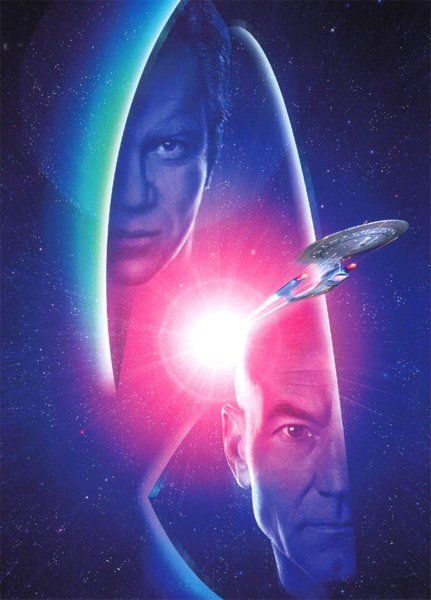
And here we are at the seventh one, Star Trek Generations, which is so obviously written around trying to bridge the step between TOS and TNG you can almost hear it whispered throughout the movie. It even has it in the title in case the hint wasn't huge enough already. It's odd really, because at the time of this movie's release, TNG had already been running for several years and was actually wrapping up. The movies were always quite a few steps behind the TV-series in this regard. You could argue that at this point TNG would already have proven to sink or swim with the fans and it's difficult to see what Generations was going to change or add. However that may be, Generations is exactly the kind of movie you would expect in advance of the launch of TNG, while also throwing in some fun for all the people who were already familiar with Picard et al (ie everyone).
In it we are not just presented to the new captain and crew taking over the rather big shoes from, mainly, Kirk, but we're also getting another and very final send-off from the TOS crew Kirk. It's not an easy task and the movie does a really good job making it work. In the desire to both legitimize the new characters and pay respects to the old ones some other key elements get lost however. The story is so busy with making Kirk and Picard a thing that pretty much everything else is secondary, like building a good narrative. The end result feels more like a tool to further a cause than a genuine attempt at telling a Star Trek story. The other movie that has this trait - Star Trek III: The Search for Spock - also suffer the same fate, they ends up being highly forgettable.
Men of the hour.
It's fortunate then at least that Generations isn't anywhere near as incomprehensive or boring as Search of Spock, despite it's weak narrative. This is of course exactly because it focuses on two of the strongest characters in the Star Trek lore, Kirk and Picard (while The Search of Spock tries to have a focus on Spock but without Spock, which works less well).
The movie starts with us following a very CGI bottle floating around through space. This doesn't make much sense until it suddenly crashes into a spaceship and breaks apart. The spaceship is the new Enterprise (since the old one was decomissioned as you'll rememeber) and Kirk is there as an honorouble guest. Everything seems to be going smoothly when suddenly some sort of gravimetric distortions appear. Caught in the middle of them are two space crafts about to be destroyed.
Harriman, the new captain, is a bit at a loss as to what to do and Kirk is required to step in. One of the crafts is destroyed before they manage to get to them and they decide to try to teleport the people off the other ship. Something stops working somewhere and needs to be fixed in order to continue the rescue, and captain Harriman offers to go first. Kirk tells him his place is on the bridge and runs off instead. They only get about a third of the people off the second ship before that too is destroyed and the part of the ship where Kirk was is hit by the distortion as well. Kirk disappears and is presumed dead. Among the rescued is a man, Soran played by Malcolm McDowell, who is adamant he wants to be sent back. We've just encountered the villain of this movie.
Fast forward 78 years and we meet the TNG crew for the first time in Star Trek movie history. It is particularly odd then that the scene that takes place is just absolutely bonkers, and unfortunately not in a good way. I'm not sure how to describe it, it really needs to be seen, but I'll give it a shot. Lt Worf is being promoted and for some reason they choose to do this by playing out 17th century pirates and navy in the holodeck. Everyone is on board a ship and Worf is being pulled forward as a prisoner. He is being made to walk the plank to catch his promotion. I... don't know what to say, honestly. Is it supposed to be funny? Is it a metaphor for something? Maybe it is just too many layers of clever for me because to me it just comes off as absurd and definitely not a good way to introduce the new crew who seem like a bunch of raving lunatics.
This might be a good time to reveal that I am not a huge TNG fan. Unpopular opinion time: TNG is not in my top 3. I've written a bit on why that is before, but the short version is that there are so very few likable characters in TNG. I pretty much don't like watching anyone but Picard and Data and that makes every episode about Riker, Worf and Wesley a chore. And there are plenty of them. Not to mention Crusher and Troi who also are huge snore fests (I was so happy when Crusher was swapped out for Pulaski, who is way better if you ask me. But apparently no one else agreed and Crusher came back). I could rant on about exactly why, but suffice to say I think the characters in the Animated Series look more alive than most of the TNG cast.
Fortunately, this movie decides to focus on the two captains, and rightfully so. In both series they are the star of the show, though in TNG the crew gets a lot more screen time than in TOS (which although the characters are badly written, I am all for).
The better doctor.
In the middle of the festive celebrations aboard the holoship Picard gets a message. As he takes off, they also get a distress signal from a Space Station orbiting the star Amargosa that is under attack. Picard is being very unlike himself, suddenly grumpy and aggressive, and let's Riker do the commanding as they go to Amargosa to find out what happened. When they're there they find Soran, who definitely doesn't look like he's 78 years older. Did he time travel, just not age or what is going on here? Soran quickly kidnaps Geordi Laforge and destroys the star Amargosa. Now why was that necessary?
Also, what was the deal with Picard? Well, he just got a message that his brother and nephew died in a fire so he's definitely got reason to be upset. He reveals to Troi his qualms about being the last in the line of Picards and this isn't the only thing that hints at the fact that there must be a series already behind this character for us to care enough about this kind of background information. The is a whole subplot about Data trying out a chip that gives him emotions, him trying to get rid of it and it getting stuck in him. It's all the episodes of us knowing how Data struggles with being human a la Pinocchio that makes this subplot interesting and worthwhile.
Well, Soran turns out to be an El-Auran just like Guinan, so he ages differently from humans. He also has not abandoned the idea of getting into the gravimetric distortion. Guinan tells Picard that she was among the crew who were rescued from the ship by Kirk and friends 78 years ago, and apparently the gravimetric distortion is some sort of paradise. It's not something you ever want to leave (though as this movie soon will make us see, Soran seems to be the only one who has experienced it and seems hellbent to return).
Soran's reasons for kidnapping Geordi are a bit unclear at first, but eventually he is going to send him back with his visor modified to allow them to spy on the Enterprise crew. Was that Soran's plan all along or was he just lucky enough that his kidnap victim happened to have a hackable visor? Soran is also collaborating with two Klingon women called Lursa and B'Etor. Sound familiar? Probably not. But because I am currently watching through DS9 I recognized that they are in the episode Past Prologue. Since they die in this movie, that episode must take place before this movie. Apparently they are also in some TNG episodes, but it's been too long since I saw them for me to remember them. Fun though that these sisters get a pretty big send off by being part of the main villain team in a movie like this.
Unfriendly sisters.
Picard and his crew manage to figure out that Soran's reason for destroying the star was to alter the course of the gravimetric distortion. This way they will pass close to a planet in the Veridian star system. By destroying that star the distortion will actually pass through one of the planets, allowing Soran to get back to them. The fact that one of the other planets is inhabited with millions of people who will die seem to not matter much to him. It is obvious that he needs to be stopped. The Enterprise chases after the Klingon Bird of Prey that Soran and the sisters are on all the way to the Veridian system.
Picard beams down to the planet where Soran is setting up the rocket that will destroy the star. The Enterprise engages the Bird of Prey in combat, and while the Bird of Prey has the advantage of being able to cloak, they are otherwise outgunned. Remember the Laforge spy though? Because of that the sisters can get the shield configuration which for some inexplicable reason is in the open on a screen in engineering. You'd really think one such vital piece of tactical information would be under quite a heavy layer of security somewhere, but no. With the shield configuration they can shoot right through the shields of the Enterprise, so you see? Really not something you should have out in the open. Worf, you have one job.
Everyone evacuates to the saucer section, and Enterprise is one of those ships that goes on these kinds of missions yet carries tons of children. I realize this specific mission wasn't exactly planned, but there really should be some rules regarding what kind of space ships children should be allowed to live on. Enterprise must've proven itself to be one of those ships that finds itself in a lot of trouble quite frequently. Through a cunning plan where they force the Bird of Prey to cloak, thus dropping shields, they destroy it. Unfortunately the Enterprise had already sustained too heavy damage to stay space born and crashes into Veridian III.
Some duct tape and she'll fly again.
And what a crash it is. It really looks quite spectacular and they have earned showing it from all the angles that they do. The hilarious thing it that it looks a billions times better than the same crash from Star Trek Beyond, but then nothing about that movie was particularly good... (but that is matters for another post!).
I haven't mentioned it before but you know what else looks really cool? The gravimetric distorsions. They are practically just swirly things rolling across the sky, but they're really well made. Whoever was the art director, hats off. Even though none of us has ever seen gravimetric distortions, these really give you the impression of looking real. In science fiction half the challenge is having people go "yeah, I guess that is how it could look/work". And they are beautiful.
So now that the Enterprise is stranded on the planet, let's get back to Picard. He tries to stop Soran but not so long story short, he fails. The star is destroyed and they are both whisked away into the distortion. In it we see him as a family man at Christmas, which apparently is Picard's version of paradise? It's been foreshadowed but it's so far removed from the Picard we see in the TV series it's both interesting and a bit unbelievable to think that this is what Picard wants most of all. Picard fights the feeling of being content and happy though and leaves his family. As he does this he stumbles into. He's as surprised as us to see her there, but she explains that she is the memory of Guinan.
She explains to him that just like a dream, he can pretty much decide what happens inside the distortion. Picard remembers that Kirk disappeared in the distortion and sets off to find him. Apparently one quirk of the distortion is that time doesn't pass. So when Picard gets into Kirk's slice of paradise, it's as if he just got there himself rather than that 78 years have passed. Kirk's paradise is his cabin in the mountain-woods, where some sort of Antonia woman he ditched "11 years ago" is still waiting for him.
This character never made sense to me.
I have a couple of questions regarding this idea of Kirk's paradise. First of all, is this Antonia woman ever mentioned anywhere else? If she is she's lost from my memory at the moment. Secondly, it would've been neat of them to throw in some mention of Kirk's son David still being alive in this version of Kirk's paradise, but nothing. Also, there is a tune playing while Kirk is riding around on a horse that sounds so much like the intro tune to Voyager. Or is it DS9? Well one of them at least. Same thing with the credits to the movie.
Either way Picard manages to convince Kirk to leave the distortion as well, to go "make a difference" rather than dreaming a pretty dream. It does fit with Kirk's character, so I don't have much trouble with the ease with which Picard persuades Kirk. But like I mentioned before, after Guinan made a big show of how this place makes you never want to leave, we've just got two examples of people who clearly didn't think it was all that. Maybe it has an extra strong effect on El-Aurans?
What follows is Kirk and Picard working together to redo whatever Picard tried and failed, but this time succeed in thwarting Soran's plans. The idea is to be respectful to both captains and also hand over the torch between them. I think it actually works really well. Kirk gets a nice self-sacrificing moment in which he... actually dies. Watching it, while I didn't cry, it really felt quite odd to see this character being ended then and there. It also means that since no one in the past knew he was still alive of sorts inside the distortion, according to actual Starfleet history Kirk died with the distortion 78 years ago.
The sequence is thrilling enough though and I try to not think of the plot hole that if they fail they'll go into the distortion again which would allow them to try to stop Soran again, and so on and so forth forever until they succeed. So either they are doomed to never succeed or they are guaranteed to succeed, there isn't just a one shot chance like they make it out in the movie.
Soran dies in an explosion, Kirk dies a hero and the torch has been successfully handed over to the new generation of Star Trek. That doesn't just go for actors and writers, but also for fans obviously. My first real venture into Star Trek was with Voyager in the mid 90's when I would've been around 10. I remember the feeling when a new episode was being aired, those times were holy to me. So while I had seen some TOS before that, Voyager is what got me to fall in love with the series. That is probably a big reason to why it is still my favourite of the lot. But no one got to follow their favourite captain as long as the hardcore TOS fans have followed Kirk. I can't imagine what it must've felt like when after almost 30 years of joining them on the adventures of him and his crew, Kirk dies. It's not just retirement and goodbye, it is ended. Kirk is no more.
Movies with such a specific check list to follow really have an unenviable task. "Generations" shows that it can be done with heart and respect for the source material however, without leaving the viewer confused and indifferent. The movie is not without its flaws though. The villain feels more like a tool (and I mean that in the writing sense and not in the derogatory sense) than a fleshed out character to care about. They do a brave attempt by tying Soran to Guinan to give him a bit more weight, but in the end we don't know enough about him or the distortion to make him a truly interesting character, like Khan. It is similar to what happens in Star Trek V: The Final Frontier when they try to make the villain more interesting by making him Spock's brother. If we still know nothing about the character it really does little to increase my interest. The Data subplot is a smart way to not make it all about the captains, and quite necessary because the lack of other crew would've otherwise been a much sorer spot for me.
I would've loved to see Kirk and Picard get more time together. I get that it's supposed to be the climactic ending of the movie, and I think that works too for the most part. But I can't help but think that it would've been a better movie if they had been able to play the two characters differences off each other for a bigger portion of the story, rather than just shoehorning Kirk in as an extra pair of hands at the end. Some potential was definitely lost there.
And that is also the feeling that stays with me when the credits roll. The writers were up against a heavy task and pulled some clever moves to bring us what in the end still is a movie with some really entertaining parts. But in the end Star Trek Generations will still leave your memory quickly, and the only thing that remains is the image of Kirk burning some eggs.
Who leaves eggs on the hob anyway?
Thoughts I had while watching this movie;
The first scene on the new bridge of Enterprise is pretty interesting because there are a lot of recognizable faces:
The new captain Harriman is played by Alan Ruck who also played Stuart in Spin City (and I know he was also in Ferris Bueller's Day Off) so I can't see him as anything but a goofball.
One of the crew is played by the woman who plays John Connor's stepmom in Terminator 2. That really threw me off because she looks exactly the same.
Tim Russ who goes on to play Tuvok in Voyager plays the operator of the teleporter - he gets brushed aside by Scotty because he can't do his job right.
There is an "Ensign Sulu" at the helm. Not Hikaru Sulu though, but a young woman. Interesting? Related perhaps? Yes, she is in fact Demora Sulu, daughter of Hikaru Sulu (who I think we briefly get to see in the background in one of the Abram's Star Treks if I remember correctly?).
Why is Dr Crusher treating Data for his emotion ship? Does she also have a PhD in engineering? I know Laforge is kidnapped, but surely they must have someone more qualified than someone who really isn't?
There is absolutely no attempt made at explaining what the distortion is or how it works. It was clearly just the first best thing the writers could come up with that would allow Picard and Kirk to cooperate, and then they wrote the whole movie around it.
Did they really have to kill Kirk? Was that the only way that character could go perhaps? I don't recall any other captain dying, so maybe he was the one that "deserved" the finality of that kind of ending.
Images from startrek.com, memory-alpha.fandom.com, denofgeek.com, Youtube.com
I don't know if I actually re-watched this not that long ago already or if this is just a bit more memorable than the previous movies, but everything felt really familiar when I re-watched The Undiscovered Country the other night. Released in 1991 it's also the first movie in the series to be released when I was old enough to possibly remember (6 years). I don't, probably because I was still only into Disney movies at that point…
The Undiscovered Country is extra interesting because to me it really is a good example of what good direction and production can do to a movie. This movie has all the possibilities to be a slog and a snore, but it manages to keep the intensity and tempo going throughout. It's obvious from the first scene that it's a comment on the relation between east and west (on actual Earth, as in USA vs Soviet) so again with the political commentary! This one does it so gracefully too, while the reference is obvious as day the end result is neither black and white nor on the nose with right answers. This is Star Trek using its voice in the best kind of way, letting the characters stand as examples of the human nature the way it was always intended. I have been nagging on about character development and relations in my previous reviews, well here they are front and center and it's respectfully and well done.
It starts after what feels like an eternal intro of just names scrolling past with some music, making me think I've accidentally jumped the movie to the credits, with us seeing Sulu as the captain of the Excelsior when they're suddenly hit by a shockwave. They find out that the shockwave originated from the Klingon moon Praxis, but the moon itself seems to be nowhere to be found. It seems like a major disaster has struck the moon which has resulted in a massive energy crisis on the Klingon home world of Kronos. The Klingon home world has basically about 50 years left to exist before it can't sustain life anymore, but when asked about it the Klingons just want to hush it down. Sounds familiar? It is pretty much ad verbatim what happened with the Soviet and the Chernobyl disaster in 1986. When this movie was written and filmed, Soviet still existed but I'm sure everyone knew where it was heading. This movie couldn't have been better timed.
Kirk, who is back to captaining the Enterprise, and his crew are three months from retiring when they get called back to Federation HQ for a debriefing on the situation on Kronos. They get told that the long standing war with the Klingons have finally come to an end and that the Klingons are dying. Kirk, who has never liked the Klingons, is visibly happy with the news. The movie refers back to the death of his son from The Search of Spock to explain is animosity, but the hatred runs a lot deeper and farther back than that of course. Kirk was already a big enemy of the Klingons in the series, but it's not difficult to see that the murdering of his son was the final straw that made any possibility of Kirk thinking otherwise impossible. It's unfortunate that the event happens in such a throw away scene in what is among the worst Star Trek movies (read my review of that to see why), but Kirk plays out all his hatred so well in this movie.
Dreamy eyes and curly hair… he didn't get much from his father.
Spock, who has been missing so far, shows up to explain that there is a possibility now to extend a helping hand from the Federation to the Klingon Empire, to show them and the rest of the Universe really that this is what the Federation is all about. They even help former enemies in need. Many, including Kirk, are strongly opposed to this idea, fearing that the Klingons would see this as a weakness and abuse it to their own benefit. Nonetheless, a chancellor Gorkon is going to be escorted through Federation space by none other than Kirk and his Enterprise team.
Kirk is fuming and has a really great scene with Spock where he basically tells him that he feels betraid by Spock even suggesting such a thing. This might be the first, or at least one of very few scenes, where we see their friendship being tried hard. Both Shatner and Nimoy play it out perfectly and when Spock tries to reason with Kirk by telling him that the Klingons are dying Kirk says his now iconic "Let them die!" with such intensity, we believe without a doubt that he truly feels that way. This first act is absolutely amazing at building up the tension and the stakes even though it's really "only" about some chancellor coming on board the Enterprise. It's done superbly with skilled musical scoring, dialogue writing, acting and direction.
New on board the ship is Lt Valeris, a Vulcan who has distinguished herself at the academy and who we soon find out Spock intends to succeed him as the science officer on board. Valeris and Spock have an interesting and significant conversation early in the movie. One of the most important aspects of it is to show how much Spock has grown and changed as a character. From practically despising his human side (and it's still not something he embraces), when he at one point tells Valeris the also now famous quote "Logic is the beginning of wisdom, not the end" we see how far he has travelled in his journey to understand the human mind and his own place within it.
BFFs. Except not forever.
When the chancellor is beamed aboard he is joined by his daughter Azetbur, General Chang and some random warriors. General Chang, played by a Christopher Plummer who clearly enjoys the role, immediately makes an impression with his interaction with Kirk which is passively aggressive in a way that a Swede like me (masters of massive aggressiveness) really enjoys. Without saying it clearly, it is obvious that Chang understands Kirk and that Kirk would rather see them all dead than helping them. What I love about it is that rather than going "oh yeah, there is the villain" you'll go "oh hmm, he clearly is someone to keep an eye on".
A tense first meeting is followed by an even tenser dinner reception in which Azetbur criticizes the humans for their arrogance and presumption that everyone wants to live their life the way they do. What a sweet and not overly subtle punch in the gut of Americanism and the politics of USA of that day.
One interesting aspect about this movie that soon becomes a bit of a confusion are the Klingons themselves. The first couple ones that we see in the movie look very human-like, with small ridges. At first I thought they were using the classical TOS design, but later on in the movie we get a couple of Klingons that look more like the ones in TNG. I don't know if the intention was to make a bridge-over of sorts between the two styles, showcasing both as an explanation for the difference (other explanations have been given, I know) but the end result is more befuddling. It seems then as if some actors just refused the more invasive Klingon make up and were allowed a milder version, but to be fair I almost prefer it that way. Without digressing too far, the way the Klingons turn out in TNG, DS9 and VOY, they're almost too much of a caricature and very difficult to take seriously. That is alright for a lot of what they do, but sometimes I end up feeling the 90's Klingons are a lot more stupid than they are cool.
Chang first had a stint as a bad-guy in Street Fighter.
These scenes between the Klingons and the Federation are tense and well done, but before we have to worry about things going too talky-talky and political the movie steps up the next gear. Suddenly the Enterprise fires torpedoes at the chancellors Bird of Prey, rendering the gravitational field on board non-operational. Two individuals in full Federation space suits, with gravitational boots and masking their faces, walk around shooting Klingons on board but we quickly find out their real target is chancellor Gorkon. When they've shot him they beam back off the Klingon ship and back on board the Enterprise is Kirk and crew completely at a loss as to what just happened. Kirk is trying to figure out whether the shots were actually fired from the Enterprise, getting the answer that the computer says yes.
Kirk and McCoy beam over to see if they can help out and start solving the massive diplomatic disaster that just happened. McCoy tries to save Gorkon but fails and Chang arrests them both for the murder. Fortunately Spock has put a glaringly obvious tracking device onto Kirks shoulder, which for some reason the Klingons don't bother removing. This is one of the few plot holes in the movie fortunately, so I'll let it slide.
Kirk and McCoy get Worf as their "lawyer", I use that term lightly because it is clear that the trial is more of a farce than meant to be taken seriously. While they don't get executed, which I guess must be seen as extremely lenient in any Klingon sentencing, they do get sent to the penal colony of Rura Penthe, which is pretty much the same thing as a death sentence and so obviously a reference to the Soviet Gulag they even refer to it as the "Klingon Gulag" in the movie. The Klingons make clear that any attempt to rescue them will be seen as an act of war.
Spock has taken over command of the Enterprise and Starfleet is ordering them to come back. Spock and the crew understandably have other ideas as they intend to rescue Kirk and McCoy but also reveal who is the real culprit. Spock uses some great deductive reasoning to come to the conclusion that the shots must've been fired by another ship in close vicinity to the Enterprise that was also invisible. A Bird of Prey that can fire shots while cloaked perhaps? Spock then further deduces that there must also be enemies on board the Enterprise, since either someone altered the records on the computer, making it looks like the shots were actually fired from there or the shots were in fact fired from there. Once they've made sure that all Enterprises' torpedoes are accounted for they have their answer and the hunt is on. While they do the search on board, they also decide to save Kirk and McCoy from Rura Penthe and head there.
Meanwhile back in Starfleet Headquarters, the plan to possibly send in a team to rescue Kirk and McCoy (despite the Klingon warnings against it) are being presented to the Federation President who, pardon my French, looks like an absolute muppet. I've seen many different make-ups throughout the years of Star Trek but what were they thinking when they came up with this one? What is he supposed to look like anyway? A wise old man? He just looks like someone who fell asleep on some hair gel and got it all over himself. I realize he is part of a species, The Efrosians, who are supposed to look like that but this one just looks so silly it detracts and distracts from every scene he is in. Fun to see Rene Auberjonois (who plays Odo in DS9, but I don't have to tell you that) in a minor role as colonel West though.
Poodle style.
Shift over to Kirk and McCoy who are getting not-so-comfortable on Rura Penthe. The penal colony is on an ice planet meaning it doesn't need more in terms of security than an anti-beam-out-field, everyone else are free to take their chances in the freezing cold. Kirk quickly makes a friend in Martia the Chameloid, aka shapeshifter who quickly agrees in helping them get out of there. Of course it turns out that the whole thing is a set-up, which also of course, Kirk sees through (not that it's hard to do) and confronts Martia. She shapeshifts into Kirk and Kirk gets to have a fun scene trying to kick his "own" ass. "I can't believe I kissed you" he says to Martia looking like him. "Must've been your lifelong ambition!" Martia quips back. Quite right Martia.
Martia's accomplices show up, only to murder her first so that there are no witnesses (what was she thinking really?). Fortunately at this point exactly, Spock has managed to make his way to Kirk and beam them both up before they get shot. Also just before the bad guy henchman reveals who the main bad guy is, but I am sure everyone but Kirk knows it by now. Spock blames himself for getting Kirk into this whole mess and says "you and the doctor might've been killed". "The night is still young", Kirk replies.
On board the Enterprise, the search has led them to two dead crewmen meaning that someone has tried to silence the killers of the chancellor. Spock and Kirk trick this person into revealing themselves and it turns out it is....... Valeris!
The funny thing here is that if you only watch The Undiscovered Country on its own, it's pretty easy to figure out it has to be Valeris who is involved with whatever is going on, simply because she is a new character in a prominent position story-wise. However, if you like me have been chaining these from the first movie, you've been primed into thinking that this is normal because of Saavik. She is a new character who is given a fairly prominent role without it actually amounting to very much. So going into this movie the first time I didn't think Valeris was going to be much more than just another Saavik. Seeing that she turned out to be one of the bad guys actually surprised me.
As they try to interrogate her we get to see Spock show some emotion, he is definitely angry and disappointed in the path she has taken when he had such high hopes for her. This scene is great and believable, throughout the movie we have got to see the two of them interact and have discussions in which Spock is trying to teach Valeris. They have a great exchange in which Valeris tells Spock that she tried to tell him but he hadn't been listening. Spock replies saying that he too had tried to tell her things, but she hadn't been listening either (basically all that stuff about logic not being the end of wisdom). When she won't answer their questions about who the mastermind is Spock engages a forced mind meld with her in another tense and great scene. Kim Cattrall who plays Valeris does a really good job throughout and even though we get little backstory or motivation on why she would act this way, she sells it and it feels believable. Simply put, Valeris is on the same page with Kirk that the Klingons can't be trusted. Interesting turn however, when it turns out that the main bad guy is none other than General Chang, in liaison with some Federation and Romulan parties. The irony of having a truce between these three groups to essentially prevent a truce between these three groups is heavy and brilliant.
Chang turns up with the prototype Bird of Prey that can fire while cloaked and is set to make an easy job out of blowing Kirk out of the skies when the Excelsior, captained by Sulu remember?, shows up to save the day. By taking some of the heat off the Enterprise, the Excelsior is buying them just enough time to modify a torpedo to be able to home in on the Bird of Prey. When the torpedo hits both ships are then able to destroy it without much trouble. The scene is made extra fun by the fact that George Takei basically shows up to save Shatner. Kirk thanks Sulu, and all I can think of is all the animosity between the two behind the scenes. It doesn't show on screen though.
This rather short battle also highlights another thing about Star Trek, namely that the shields of the ships seem to do different things depending on what is needed for the story. In this scene specifically the shields of the Enterprise are up throughout (except right at the end) but the hits from the Bird of Prey still hit the hull. In other fights the shields seem to absorb pretty much anything until they fail. So I've never really understood exactly how the shields work to be honest. Guess it's just one of those things that changes depending on the mood of the writer.
What I haven't mentioned so far is that chancellor Gorkon's daughter Azetbur has taken over his role and moved the peace talk conference to a secret location. Kirk and friends find out where it is and rush there just in time to thwart an assassination attempt on the President. THE END! Almost.
Then we get the ending... and it is THE Ending with a big E. Everyone is about to retire, the Enterprise gets ordered to come back to be decommissioned. This is it. All the actors and all the people watching the movie know that they are turning over the reins to the next group of people, when this movie was released The Next Generation had already been on air for four years. Fortunately, after a fun ride of a movie, they don't botch things here and do something overly sappy or long like in Lord of the Rings. "So this is goodbye" says Chekov. Spock basically suggests they tell Starfleet to "go to hell" and after looking around the room of the bridge at each other they unanimously decide to yet again ignore Starfleet orders to return to dock. When Chekov asks Kirk where they should head next he answers "second star to the right, and straight on til morning". Which apparently is a reference to Peter Pan, I never knew. Until just now. Then Kirk wraps it all up neatly by announcing that the next generation are going to "boldly go where no man, where no one, has gone before".
It's nice and neat and actually quite sad. It's a lovely finishing touch when the credits start with the main actors signatures going across the screen, like they are all literally signing off on this project. We know now that some of them turn up again in other Star Trek projects, but when the movie was released this must've been a very heavy moment for true Star Trek fans.
This movie has a lot in-common with A Voyage Home in that something about it just works. Although a lot of it is essentially material that could've turned out boring, the movie manages to keep a good pace and intensity throughout that never fails to keep my interest. The two movies are completely different in tone, yet there are some key components that they share that could go some way towards explaining why I enjoy them both so much;
1) A contemporary setting. By this I mean that they both place the crew in a story that makes them feel relevant to us here and now (obviously especially at the time of release but they hold up). They manage to find a way to connect the viewer directly with the events taking place, giving us that oh so important feeling of being able to relate. 2) A focus on the relationships between the different characters of the crew. I said it in my review of A Voyage Home as well, but capitalizing on the time we have invested in getting to know these personalities and how they would interact can pay off so much when done well. When done with the respect to the viewer that you believe that they will understand subtle meanings in dialogue simply because we know what these people are like in different situations. 3)Well-written dialogue that make for really fun to watch and memorable scenes, scenes that not only are enjoyable the first time around but that you want to return to.
And when the credits roll you realize what an awesome thing the entire movie manages to pull off in not only being a commentary on the "Undiscovered Country", ie future, of contemporary actual events going on in the world, but also the future of the Star Trek franchise. This is exactly what Star Trek is about. It manages to make it look effortless when it places itself smack in the middle of fiction and reality.
The end result is a worthy and respectful goodbye and definitely well worth watching.
Images from Wikipedia.com, fanpop.com, trekcore.com, memory-alpha.fandom.net,
Non-sensical and non-descript, just like the movie.
I'll be honest, I was kind of dreading this. Not only is The Final Frontier considered to be among the worst of the Star Trek movies, I also remember really not liking it. Interestingly enough though, having re-watched it now for this review, I found a lot more redeeming factors than I ever thought I would. But maybe me going in with the lowest of expectations really helped things along.
Don't get me wrong, this movie is in fact bad. But the main issue here is the story, which is convoluted, boring and honestly makes no sense at all. However, sandwiched in-between a lot of scenes that have straight up bad writing, is a lot of stuff that actually could make this movie worth watching for a Star Trek fan (at least if you've run out of other TOS content to watch). The jargon and banter between Kirk and Co are some of the best they've ever been and we get to see a lot more character development (by other crew members than Kirk) in this movie than in the first three (TMP, TWOK and TSFP).
But seriously, what is up with the story? The movie starts out with a scene of Kirk free climbing some mountain side while McCoy is on the ground, rightly being worried out of his mind about Kirk falling to his death any second. Spock shows up with his rocket shoes just before Kirk falls (arguably also being the cause of Kirk falling) and saves his life. I find that this initial scene epitomizes basically all the pro's and con's that this movie has. In itself it makes little sense and if it's going for realism (within the boundaries of the Star Trek Universe) it is laughable. I don't actually know what age Kirk is supposed to be but Shatner himself was almost 60 when this scene was shot, and while I'm not saying that no 60 year old ever could free climb that far up a vertical mountain side, to suggest that Kirk could is just not very believable (although still in-character that he'd definitely give it a try). Secondly we have Spocks rocket shoes which defy all physics and logic (pun intended), although I'll throw in a caveat for the possibility that they've invented/discovered some alien technology in the future that could work the way they do in this scene. At face value this scene is poorly thought out and realized.
But then, later on in the movie, we get to see that both these things - the rock climbing and the rocket shoes - come in handy again, so this entire scene was set up as a foreshadowing of sorts. Clumsily made so still far from perfect, but at least it gives the existence of the scene a bit of purpose. Also, within it is some decently written dialogue between the characters, allowing them to banter and bounce comments at each other just like we love to see Kirk, Spock and McCoy in action. So what is the end result of the scene? That this movie is going to be a mixed bag, and you need to go into it hoping for light hearted crew-fun, and not a smartly written, well-paced story.
In many ways this movie superficially resemblesThe Voyage Home this way, where the story takes incredible short-cuts to be able to tell you about a fun adventure of Kirk and his crew. The big difference is that The Voyage Home has the funny and clever dialogue fit in and lift the story, but in the Final Frontier the story and dialogue seem like they've been written by two very different people with two very different movies in mind (the story was in fact co-written by Shatner, Harve Bennett and David Loughery.
I've been trying to stave it off, but at this point I feel I need to go into the story before we move on; After the rock climbing scene we are taken to the planet Nimbus III, also known as the Planet of Galactic Peace. Nimbus III is, pardon my French, a sandy s*it-hole, and being stationed here should be and is considered a demotion. In the bar of the "town" called Paradise is a dancing cat lady with three boobs that just feels so extremely 80's. Why a planet that seems to lack any basic infrastructure was chosen as the site to advance peace between the Federation, Klingon Empire and Romulan Empire is anyone's guess (no one had tactical advantage possibly). How they think it's going to happen without actually having any diplomats there to do the talking is also a mystery.
Welcome to nothing.
I'm going to correct myself though, there are in fact three diplomats (one from each) and they get kidnapped by the main villain, of sorts, in this movie - an emotional Vulcan named Sybok, who also turns out to be Spocks half-brother (Spock seems to have mystery siblings all over the galaxy). Kirk and crew get called back from shore leave to take a barely functional Enterprise to rescue these three hostages. Kirk asks if there are no better ships and gets the answer that there are better ships but no better commander. So why not give Kirk one of the better ships? Anyway... they don't do that. On the way to the bridge Kirk comments that he needs a shower and Spock turn to him and says "yes".
Meanwhile, a random Klingon Bird of Prey discovers the Enterprise, their mission and the fact that Kirk is on the ship and decides to pursue them to kill Kirk for glory. It's ok if you completely forget about the Klingons because they barely fill any function in this movie at all.
Since the teleporters aren't working, Kirk and crew need to go down to the surface of Nimbus III in a shuttle to do the rescue and we get to see Uhura dance naked in the desert moonlight and Spock do a neck pinch on a horse. Kirk gets attacked by the cat lady from the bar and she has some absolutely astonishingly bad sound effects.
When Kirk is about to rescue the hostages it turns out the entire thing was just a ruse, the hostages were in on it with Sybok. What did they want? A starship, and the Enterprise will do. What are they going to do with it? Take it to Sha Ka Ree, or as it is called in Terran - Eden. That's right, Sybok is in fact certain he has found the location of Paradise and God itself.
The actor does what he can with a character that needed a lot more work.
On the way back to the Enterprise in the shuttle, the Klingons on the Bird of Prey show up (bet you had forgotten about them already) and threaten to kill them. Kirk outsmarts them and Spock briefly gets a chance to kill Sybok. He chooses not to and when Kirk has an anger fit at him he reveals that Sybok is his brother, but to a Vulcan princess mother. He tells Kirk that Sybok was exiled from Vulcan for his beliefs, but a few scenes later when they talk about Sha Ka Ree he exclaims that trying to find it was the reason Sybok left Vulcan. They get put in the brig but Scotty jail breaks them out of there.
As they try to sneak to regain control of the ship there is a genuinely hilarious scene where Scotty gets captured by knocking himself unconscious on a bulk head - it's so unexpected and silly.
Apparently Eden is located inside something called the Great Barrier from which nothing has ever come out of after entering. Kirk isn't too keen on taking the Enterprise in there, but Sybok has a way of talking people into doing what he wants. He gets all of Kirks crew on his side by allowing them to face their biggest fears and take strength from it. He immediately reminded me of a televangelist in the way he does it, which probably is a good thing since that is where Shatner drew his inspiration. Even though Spock and McCoy go through with Syboks "treatment" they decide to stay with Kirk. Kirk refuses to face his fears and tells Sybok;
"I don't want my pain taken away! I need my pain!"
Which I think really says a lot about Kirk.
The scene where McCoy and Spock get to face their inner fears has potential to be interesting. McCoy feels a lot of pain about letting his ailing father die too soon and Spock feels pain about Sarek thinking he is too human. It's not a scene that makes a lot of sense though, because even though we know Spock struggles a lot with his humanity, even Spock must know that whatever Sarek thinks about humans he still chose to marry and have a child with one. The way the scene plays it out it seems like Sarek really dislikes humans, which clearly isn't the case.
In fact, Sarek and Amanda is one of the better written love stories in Star Trek.
The scene as a whole isn't well designed either, as it's not entirely clear what exactly happens. Are they seeing visions? Can other people see what they see? It is hinted that they can, but how does that work?
When Kirk finds out that Sybok is searching for God he tells him that he is mad. "Am I?" Sybok asks, with a great and telling expression on his face. The actor for Sybok, Laurence Luckinbill, really nails it there.
They go into the Great Barrier without any trouble and find a planet. Sybok hands over the control to Enterprise back to Kirk saying that now that they are here he is convinced that Kirk wants to explore the planet too. He's not wrong. "If we are going to do it, we're doing it by the book" Kirk says, only to say "Ok, we'll play it your way" to Sybok the scene after. The people still on board are watching the people on the planet on the view screen from a camera angle they couldn't possibly achieve.
We never get an explanation to how Sybok figured out God would be at this specific place, but they do find something. At first they think it actually is God, but Kirk (of course) starts to question it and when it responds malevolently they realize it's just some alien creature trying to use them to leave the Great Barrier. Sybok sacrifices himself by throwing himself at the alien, thus saving the others although I have no idea how that works. It also makes you wonder what happened to every other ship that entered this area. What should be the great climax and raison d'être for this movie is over and dealt with in a matter of minutes and it feels absolutely pointless.
A lot of work must've gone into that beard.
But! We mustn't forget about the Klingons! They show up, having pursued the Enterprise all the way into the Great Barrier and...!... Get talked into not attacking by the diplomat Klingon from Nimbus III who is on Enterprise. So... the Klingon presence filled zero real purpose and fizzled out into nothing, just as pretty much everything else in this story line.
The story is incomprehensible and uninteresting, and the story isn't the only problem with this movie. The special effects are among the ugliest I've seen (though not Jaws: The Revenge ugly) and definitely worse than all of the previous movies. There is a scene of the shuttle craft where I genuinely cringed. We are far from the majestic beauty and storytelling from The Motion Picture here.
But if you try to ignore what the movie is trying to tell you, and you really should, there are quite a few really fun and delightful scenes with Kirk and Co just being everything that made TOS so much fun to watch. In many ways it nails some of the same joyfulness of The Voyage Home, but without the interesting and clever framework to hold it together.
And there you have it - overall this movie deserves all the bad reviews it has gotten. But, I'll be honest, even though the story is bad it's still not as boring as The Search For Spock and this movie also has a lot more fun scenes between the crew than that movie has. So in the end I've actually got to say that this isn't the worst Star Trek movie and not even the worst of the first five. I can't say I recommend watching it, but it does have some redeeming factors to it and it ended up being less horrible than I had expected. It's might not be praise but it's something.
Thoughts had when watching this movie;
Wait a minute, didn't Sybok have long hair just now? And when they land on the God-planet he suddenly has short hair.
Images from IMDB.com, memory-alpha.fandom.com, tor.com, laymansbible.wordpress.com.