Sunday, January 28, 2024

Timelapse (PC, 1996)

I have a "will they, won't they"-relationship with puzzle games. I love them, I want to be good at them but I just ain't. I have found the perfect place for them in my life however - as something to do with my kids. Turns out, trying to solve puzzles together is just as fun as playing any other old game together. Me and my son (now 10) have played a whole bunch so far, all through The Room 1-4, World of Goo, Trine 2 and now we played through a little gem called Timelapse, released in 1996 by GTE Entertainment (the "content creating" subdivision of GTE Corporation that later became Verizon).


I had never heard of Timelapse before it somehow ended up in my games library on GoG (I really wonder how some games end up there...). It looked a lot like Myst, which I have not played but remember watching my mom play through back in the 90's, and I thought maybe it could be a fun challenge for me and the kid to try out.

Turns out it was, I'll even go on right now and spoil my end conclusion by saying that Timelapse is a bit of a hidden gem as far as Myst-likes go. So if you don't feel like reading farther than this, just know that this is a game worth your time if you like that genre.

Don't worry too much about the story. As far as I remember it barely makes sense in Myst, and it barely makes sense in this game either. I would like to recap it, but honestly I only understood half of it so here is my best try - you're helping some sort of dude, maybe a professor, to look for Atlantis. You can travel to different eras and civilizations in time that seem to somehow be connected to Atlantis through sheer myth-building, like the old Egyptians, the Maya, Easter Island and the Anasazi. In each of these locations you need to solve puzzles to move on.


So let's not dwell more on the story, because the real star of the game has to be the puzzles. For any one not used to puzzle games it is easy to believe that there is just one way of crafting them. Nothing could be further from the truth. There are quite a few different ways you can design puzzle games, here are some off the top of my head (there are more, and there are some that mix them, like Resident Evil);

1. The "fake" puzzle games, like The Room, which actually just require you to find one item to open an item to find an item to open an item and so on. There is little puzzling and mostly searching, in these kind of puzzle games.

2. The environmental puzzling which mainly require you to manipulate the environment to get through the game, like the aforementioned Trine-series and World of Goo.

3. The "real" puzzle games which present you with puzzles that are superficially connected to the game world and/or story, but really are designed to be self-contained puzzle challenges. In this category you'll find games like Myst, Timelapse and Safecracker.

Timelapse is definitely in the latter category. While the puzzles are presented as to fit in the general esthetic of each area, the puzzles themselves don't necessarily logically connect to anything in the world. It's the classic trope of puzzle games, if you think about it too much it doesn't make sense that you would have to play game of Snakes and Ladders to be able to open a certain door. Or a game of Simon Says to be able to open a certain chest. We ignore all that, as long as the puzzles are well designed.

To my amateur eye I find the puzzles in Timelapse very well done and fun to try to puzzle through. Very few of them were so weird that I felt like I never had a chance to get it. They range from the abovementioned examples to finding patterns, assembling objects and traversing courses. At your disposal is a journal full of information and quite vital to your puzzle solving. It also contains a lot of interesting information about the civilizations you are visiting, if you're interested in that. Even if the journal, and a camera that allows you to take pictures of important clues you come across (the camera bugged in my version of the game, so I ended up never using it), I had to take so many notes of everything we saw. Quite a few puzzles require you to take not of a series of symbols in one area to be able to decipher a series of symbols in another area. 

Only once in the game is there a time limit to what you do, and if you fail you get the bad ending. Fortunately this part is right at the end, allowing you to simply try it again to see if you can manage differently.

The controls are fine, just like in Myst you move around the world with arrow keys (or WASD) through different screens. An arrow at the bottom always shows you which directional options you've got and there is a map as well. I still got lost quite a lot however, but my kid didn't so I think that is more indicative of my sense of direction than anything else. You don't have an inventory per se, so no worries that you're going to have to carry around a lot of random objects that you need to figure out where to use. You can only ever carry one item at a time, and it's only usable in the time period it was found. 

The times you have to manipulate objects on the screen you notice the age of the game. Knowing where the game wants you to place something or click on the screen to make something happen can be patience testing and time consuming for some of the puzzles. Fortunately these are rare enough to never ruin the overall experience.

To your further enjoyment, this game is of course full of extremely badly acted FMV's. Think Command & Conquer, or of course Myst itself for that matter. The sound effects and music are what you'd expect from the time, looped stock and completely unobtrusive background jingles. Nothing that you will remember fifteen minutes after you've turned the game off, neither something that will annoy you in the long run.

It took me and the kid around 10 hours to complete the game, scattered across a year roughly. We played it in bouts. Whenever we got too stuck on a puzzle we moved on to something else, but we always came back to this. We definitely had to use a walkthrough for some sections (especially the symbol deciphering), but a lot of it was possible for us to get through with mental team work. There was a fun variety of puzzles and we both really enjoyed it.

GTE Entertainment closed down just a year after Timelapse was released, so even though the end of the game teases a sequel, it sadly never came to be. It is unfortunate, because I definitely would've loved to check that out.

Sunday, January 7, 2024

Middle-earth: Shadow of Mordor (PC, 2014)

Some times you can almost see exactly how the pitch meeting went down in a game, book or movie. You can see the checked boxes, the business research that went down and the cogs and wheels behind different choices and functions. When some thing is by the numbers, it is rarely entertaining. By the 7th and 8th book of Harry Potter, I could almost see how J.K Rowling knew it was going to be turned into a movie, and it had almost turned into a bland movie script instead of the original, charming adventure it had started out as. Or just take a look at the last couple if Disney movies to see how to not make a movie based on what you think your audience wants to experience. There is no passion, just a desire to get things done as quickly, and profitable, as possible.


With some games however, this glaring obviousness in game design doesn't always turn out to be a bad thing. Even if the thought process behind the game design of games like Thief, Deus Ex, Dishonored and even Mario games is obvious at a first glance, there is a core idea and a want to pursue something fun that is missing from something that is purely created to fill some wallets. 

I am not naïve enough to think that that wasn't the main motivation for the beforementioned games as well, yet they manage to still create that ever elusive "flow", or the feeling that I as a player am in control and the game is my oyster to explore.

Middle-Earth: Shadow of Mordor is a game with its blueprint obvious to the player. Every new skill you acquire, every new enemy you meet, the step-by-step of progression is obvious and easy to detect. But it manages to find a pacing and rhythm in the combat button-mashing that just ends up being good old, simple fun.


I've had my sights on Shadows of Mordor for a while. Ever since it came out it was one of the few Lord of the Rings games to catch my interest. I have a pretty neutral relationship with the Lotr-franchise overall. I absolutely loved the first film and enjoyed the other two. I thought the books were pretty so-so, but love the Hobbit. The Hobbit movies on the other hand are a good example of the abovementioned board meeting gone wrong. So I'm not hype with every new Lotr thing that comes out and have had close to zero interest in the new TV-series or the MMORPG.

There was something about Shadow of Mordor that seemed to make it stand out though. Gone were elves, dwarves, rangers and dragons (not that I particularly mind those). It seemed a tighter, more controlled environment where the setting was just an excuse for what was reviewed as good gameplay. It lingered in my backlog for years, as games tend to do, until I decided it was time to bash some orc skulls.

You play as Talion, a human who dies during an orc/uruk attack in the opening sequence (I won't distinguish between orcs and uruks, though I know it will probably annoy some Lotr purists. When I type "orc" or "uruk" just assume I mean one or the other). The game is thus off to an interesting start. Fortunately it doesn't end there. Talion is possessed and saved by a mysterious elven ghosts (ok, so there are some elves in the game). Finding out who this is, is part of the main story line.


You're dropped into a world which could be optimistically described as tragic, more accurately described as 50 shades of brown. You won't see any trees, butterflies or cute lite rabbits running around this place. You're in fact in the vicinity of Mordor and surrounded by orcs and their human slaves everywhere. At first it's easy to become a bit overwhelmed and think that you won't stand a chance against the sheer number of enemies. 

Fortunately Talion is exceptionally skilled at sneaking around. Unlike your protagonist in Thief or Dishonored however, Talion is also a beast when it comes to direct combat, and you quickly learn to deal with hoards of 10-20 orcs and more. 

It would be easy to pick apart the game design choices here - there are convenient bushes to hide in every 20 meters, Talion can climb pretty much any surface better than a mountain goat, the orcs behave predictably, and also stash an unhealthy amount of explosives right next to their camps and so on and so forth. But that doesn't really matter. Tetris has, after all, an extremely predictable game design. The fun comes in trying to plan your advance and attack based on the knowledge that you have on hand. Will you sneak up to a tower and jump the Orc Leader from above? Will you let loose a caragor and try to attack in the confusion? Will you pick the orcs off one by one or try to go in swords swinging?


There are many choices
and they grow as you process through the game. Where you start out pretty simple with a few ways of attacking and defending yourself, you quickly unlock an arsenal of options that allow you to handle fights in more ways. Of course the game then also presents you with new and more difficult dangers to take into account. Overall the level design and combat is very well throughout and designed, it keeps up the fun through all the 15 hours I have played the game so far.

That isn't to say it is perfect however. The game allows you to control and execute a vast array of skills in just a few button clicks, which means they are mainly context-bound. This means there will be situations where the game thinks you want to do something you don't. This is especially true for trying to interact with the environment, like climbing and jumping things. I've been stuck on small thresholds on the ground with 40 orcs around me, because the game is trying to climb something that clearly just needs running over. I have been stuck in "sneak along the wall"-mode when all I wanted was to pass the wall running. I have jumped off things the wrong side because the game can't decide which way I am looking.

But this has never been the cause of my death, just some sweaty and sweary moments. In all the abovementioned cases I can see the logic the game algorithm is trying to apply, it was just a few steps behind or ahead of my own thought process resulting in some hilarious moments where Talion is seemingly humping some wall trying to climb it while I am desperately trying to not get killed.


But overall the system has probably saved me a lot more than it has put me into trouble, and I think they've done a good job balancing your skill with the overwhelming odds that you're some times up against. It rarely feels too easy, it rarely feels unfair.

The voice acting is good. I thought I recognized Talions voice and yeah, duh, it's Troy Baker from Batman: Arkham Knight and The Last of Us fame. All the orcs sounds suitably angry/dumb like they're supposed to as well, and I actually enjoy the little cut-scene of smack talk that comes every time you encounter an uruk captain.

The story is set apart from the other things I have seen from Lotr so far, like the movies and the books. Spoiler alert, but as far as I've gotten there are no hobbits or white mages as far as the eye can see. And I like that. This is about other people having the same fight but elsewhere in this world. It actually makes the world more real, the fight more urgent. I can imagine that Frodo is working is way through some bog at the same time I am slitting throats in my corner of Middle-Earth. I could've also gotten this completely wrong and maybe Talion lives in some other time, but it doesn't matter. The story is just the frame work to get you into the action.

Playing Shadow of Mordor I can easily sink into the game world and pretend I am a badass ghost-riddled uruk-slayer, slowly chipping away at the dread that is Sauron. It's not profound, but by golly is it fun -  the same kind of fun watching a Godzilla or Jackie Chan movie gives. You know what you're going to get, but it is exactly what you want.

Saturday, December 30, 2023

2023 Review - Best Viewed and Read

 2023 is at an end and it is time to look back at the year that has been and summarize - what was good and what was bad? Any New Years resolutions to break?

I try to keep track of the games I play, but I am very bad at it. Because of this I unfortunately can't make a good list of my favorite games this year. I also don't really play enough of them to make a list of best ones, I guess. I recall replaying FFVII and that was just as great as I remembered, which I was relieved to experience as I had worried my rose-tinted goggles might've been at work. No, that game still holds up 100% and I had an absolute blast playing through it again. Other than that it has mostly been World of Warcraft: Wrath of the Lich King Classic and me trying to squeeze in other games, and some blogging, in-between. 

My personal year has been good, other than my washing machine breaking down and me having to wash our clothes at my work for the two weeks we waited for a new one to arrive. But it is here now and it is doing what it should, so that problem is solved.

Best Books of 2023

These are by no means new books or released anywhere near 2023, but simply books I've read during the year. I read about 50 books, if you count the Judge Dredd Collection of series, which I do. Here were some of my favorites;

1. Judge Dredd - The Complete Case Files

A collection of every Judge Dredd series released in the 2000AD magazine and they are all amazing. I love reading them and I am happy there are many more for me to get. I am at the 7th book when writing this and I think they've released 42 or so. I tried thinking of some favorites, but I actually really enjoy them all - big stories and small ones alike. I'd love to explain the concept, but it needs to be experienced to be fully understood. In essence, Judge Dredd is a supercop in the future, handling all kinds of extremely crazy future problems. The tone is satirical, dark and far-out imaginative. I'm endlessly impressed by the writers abilities to come up with more and more crazy stories.

2. The City of the Chasch by Jack Vance


Not an amazing book by any means, and maybe I just liked it because I was so positively surprised that it wasn't as bad as I expected. Some time ago I acquired a haul of old sci-fi "classics" released in Sweden, in bad Swedish translations, under the Delta Science Fiction name. Most of these books have been a chore to get through. Out of the 30 or so I've read so far, maybe two or three have been worth reading. The City of the Chasch was one of them. The main character Adam Reith is sent out from Earth to investigate a distress signal on a planet called Tschai. After a crash landing he find that the planet is inhabited by loads of sentient species, many of which keep what seems to be humans as slaves. The humans themselves don't remember being from anywhere else, neither seems anyone else. Are these humans actually from Earth? The book has good world building and an interesting mystery at its core, it kept me entertained throughout but is part of a series so I haven't read the conclusion yet.

3. The Three Musketeers by Alexandre Dumas

The Count of Monte Cristo is my favorite book ever. Of course I had to see if Alexandre Dumas could pull it off again. And he does. The Three Musketeers is also an amazing, fun and exhilarating read and none of the movies I have seen do it any justice (which is also true for The Count of Monte Cristo). The story of how the young adventurer d'Artagnan befriends the musketeers Athos, Porthos and Aramis (not their real names by the way) has everything you want in a good book.

4. Anything from Bitmap Books

This year I read Game Boy: The Art Collection and The Secret History of Mac Gaming. I already own two or three other books from these publishers. If you're into video games, nostalgia, well written facts and pretty pictures, these books provide and then some. The quality and design is superb and the books themselves are almost works of art. It helps that the content is great too. Definitely check them out, they're worth every penny.

Best Watched in 2023

I don't watch many tv-series, but I've seen a fair few movies. Here were some standouts;

1. TMNT: Mutant Mayhem

I enjoyed Rise of the Teenage Mutant Ninja Turtles: The Movie, without having watched any of the TV-series. So I decided to give Mutant Mayhem a chance too. I loved the quirky animation style, I loved the characters. The humour was spot on TMNT. Very entertaining and worth checking out if you're into TMNT.

2. Violent Night


A friend of mine recommended Violent Night, probably knowing what kind of action I am into. And this movie delivers. It's such a whacky concept that it takes all the way, and it even works better than Tommy Wirkola's previous movie Dead Snow, which was also fun. I love John Leguizamo in anything, yes even Mario Bros and Spawn, and he is great here (so is Beverly D'Angelo is a badass matron). But of course the real hero is David Harbour as Santa, and the writing.

3. Indiana Jones and the Dial of Destiny.

I don't care what anyone says, I think this movie was absolutely great. I watched it with my kid in the cinema and had good old matinee fun! Because this was the first Indy movie he saw, we of course had to go back and watch all the other ones too. It was fun to see him recognize characters from the earlier movies and Dial of Destiny is a worthy successor. I like it better than Temple of Doom and Kingdom of the Crystal Skull.

4. Lightyear

I hadn't watched this yet and because I have been disappointed with most Disney outings since Toy Story 4 my expectations were low for this movie. It wasn't improved by the fact that reception was bad as well. I was very pleasantly surprised then to find a really neat sci-fi movie in Lightyear, and probably one of Disney's best movies in years (I also quite liked Onward). It gave me some hope for Disney, but watching "Wish" later this year squashed a lot of that...


What were your standout experiences in entertainment this year? I am always up for good tips in the reading, watching and gaming department.

Tuesday, December 19, 2023

The Temple of Elemental Evil (PC, 2003)

People have a tendency to return to things that they actually really disliked the first time around. Things like giving birth, old relationships, the LFG-tool in WoW Classic... Where you first went "never again!" your brain slowly starts to whisper "was it really that bad though? Maybe you just did it the wrong way? Maybe this time it will be better because you know what to expect?". Those rose-tinted goggles can be dangerous.

This is the relationship I have with games that apply the Dungeon & Dragon gameplay system. I've tried a fair few so far - NeverWinter Nights, Baldur's Gate, Icewind Dale to mention the classic ones. The only one that I managed to get farther than a few hours into, and in fact complete, is Planescape: Torment, which I actually really enjoyed.


Without fail, every time I try these games I have high hopes of a fun, party-based, turn-based, story-driven RPG to sink my teeth into but after a few fights I always get reminded of how evil these games are and quite frankly just badly designed. 

Everything revolves around wasting the players time and around having the feeling that you don't have all the information you need to do a good job.

Unfortunately, The Temple of Elemental Evil turned out to be no different in this regard. I went in with my classic hope of finally having gotten the grasp of these games, like the fact that you simply can't play with certain classes unless you're mega-pro, because they are too weak. And even when you have a whole party full of seemingly battle-worn adventurers that should be able to do everything from smash skulls, shoot lasers and mend wounds in-between themselves, they always turn out to be a bumbling mess of kindergartners who couldn't hit the side of a barn if it fell on them.


How was it ever considered fun that every character you play is so incredibly bad at everything they do? If I have a Rogue I expect them to be half decent at picking locks, or sneaking or setting traps or at least something. If I have a Barbarian I expect them be good at breaking things. If I have a sorcerer I expect them to be ok at throwing a spell or two. But that is just not how the Dungeon & Dragon rule set works and I can not fathom why anyone thought this was a good idea?

So I choose my first line-up, a Warrior, Sorcerer, Cleric and Rogue. Immediately I learn that the very first and weakest mobs you come across can easily hit you for 3-7 damage but my Clerics "Heal Light Wounds", which he can only cast once before he needs 8 hours of rest, only heals for 1 damage. Oh and speaking of resting, if you're in a safe zone like a city you can only rest in an inn which costs money. If you're in the wilderness you will get attacked by mobs if you try to rest. Every 2 damage any of your characters have taken, and they will take a lot of damage, takes a whole day to rest up.


This just results in a flurry of quick-saves, quick-loads and running back and forth between the town and the questing area. All the while you're doing this, your characters get stuck in the environment, behave according to their "personalities" which just means they won't do what you ask them to and overall act like the opposite of my idea of fun. I literally have a character in my party who picks up everything I loot and refuses to hand it to anyone else or sell it. He is so encumbered and just hoards all my stuff, such a prick!

I haven't even gotten around to talking about the story or the setting or the atmosphere. There is just so much frustration in me trying to navigate the controls and lack of control that I can't think of anything else or enjoy anything that might be good.

The alignment you choose (a mix of Good/Neutral/Chaotic) affects which party members you can have and also which starting quest you get. From what I can tell they still get you to the same starting area, which is a little country town called Hommlet. I quickly find more people to add to my party in Hommlet, for which I am immensely grateful. So far the only character remotely useful however have been rogues and barbarians. Everyone else either can't hit for the life of them (literally) or die in two hits. If I had a 6-man party of only rogues and barbarians I would probably do ok at the beginning of the game. I suspect the end of the game will not be as easy though. The game design expects and in fact requires that you carry half your party for a big part of the game because they won't be useful until later.

I find a few quests, some require me to try to negotiate small village quarrel, but some are more interesting. I get way-points on my map and decide to explore them. A plus for the game is that enemies don't seem to respawn once you've painstakingly got rid of them. But a huge minus is that, as mentioned, after practically every fight I have to travel back to the inn and rest. There is no challenge in that, just a waste of my time.

I've played three hours of this game and I have only managed to finish the very first quest, which literally only tasks you to find a certain someone in Hommlet. And even that took me over two hours to figure out. Maybe I am just really, really bad at these games...

It makes me a bit sad, because I am sure there is a decent game buried under all the evil game design. But to look on the bright side, as someone closing in on 40 it isn't often I get to feel too young for something, but I am definitely too young to understand this game.


So I give it another go.

This time I go in with a different mindset. This game isn't about going in guns a-blaze, it's about thinking, preparing, utilizing every tool and skill at your disposal. Instead of running my group around I sneak with my rogue, allowing me to prepare for fights that come ahead (which slightly improves my chances of survival). 

Instead of sending every character to try to chop the enemy's head off I carefully select their positioning, paths and skills to make sure they get more hits off than the enemy (which slightly improves my chances of winning).

Instead of thinking the game will come to me, I make sure to explore every nook and cranny, really listen to (carefully read and take notice of) what people say to me (which slightly improves my chances of finishing quests).

I save after every achievement, every little step forward. 

And I get a glimpse of an entertaining game, with no hand-holding, that wants you to deserve the good bits with blood, sweat and a lot of patience. But that much patience, unfortunately, I am too old for.

Sunday, December 3, 2023

Moonlighter (PC, 2018)

 I've played a fair bunch of roguelites and even at their worst they always offer a few hours of fun. At best they manage to find exactly the right balance between challenge and "just another go" to keep you hooked for hours. So which one is Moonlighter? 

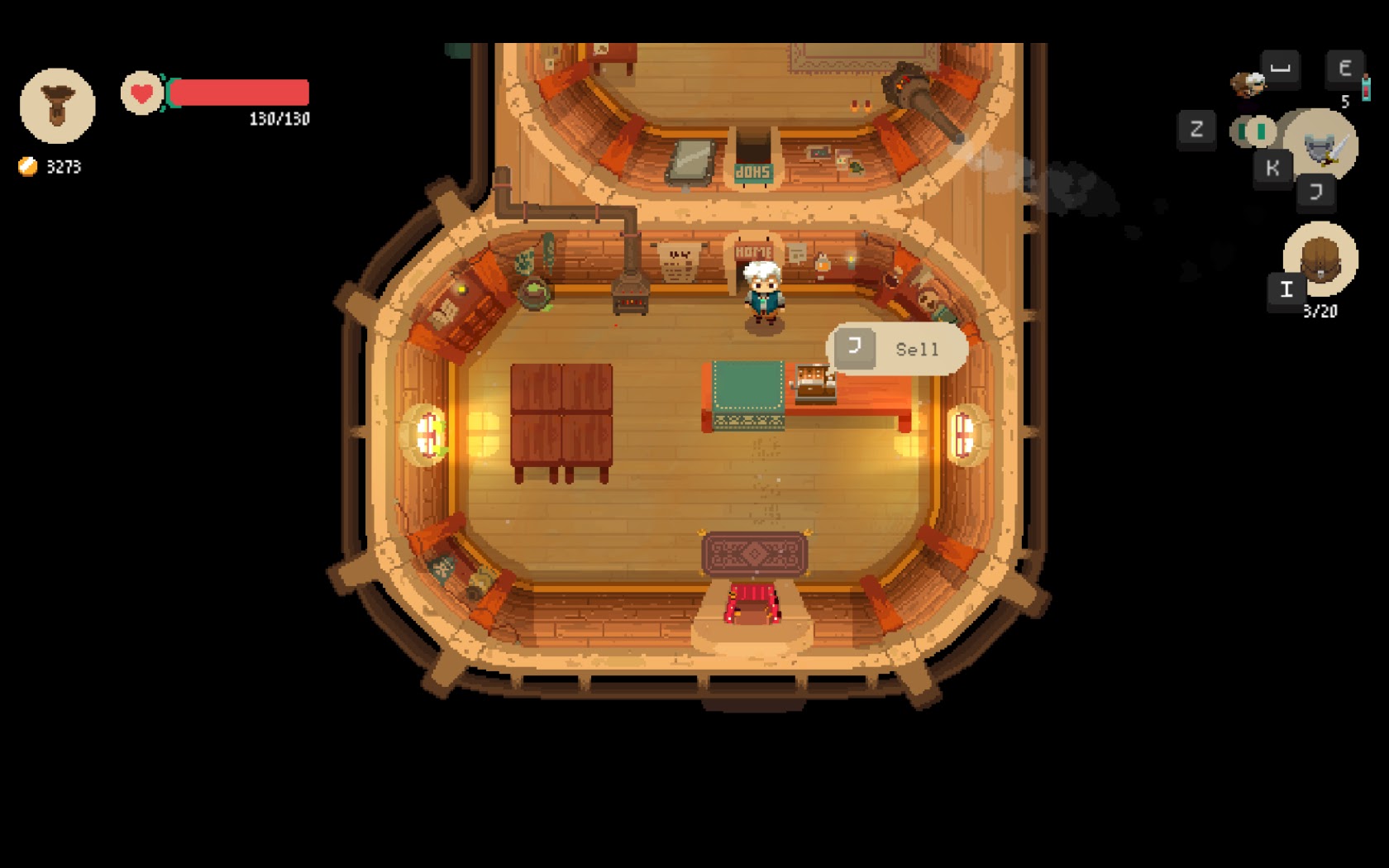
Moonlighter is a roguelite with a pretty straightforward concept - go into dungeons, get loot, sell loot, improve gear, go into more dungeons and get more loot. It's a loop that we're all familiar with at this point. The tiny twist to Moonlighter is that instead of selling your loot to some store, you are the store, selling your loot to other people.


It's a minor difference, but it's a fun idea. You own a store that you can improve in different ways, allowing you to make more money off the stuff you have pried from dead monsters in the dungeons. With the money you can also invest in your hometown - purely for your benefit of course. This is how you get access to a potion-maker and a blacksmith for instance.

You decide what to charge for your items, but the people who come into your store aren't willing to pay just anything for your stuff. There is a sweet spot where the buyer thinks it's worth it and you think you're getting enough. The game gives you a well designed system for keeping track of what different items are worth. It also helps you keep track off items you might want to keep to use for potions or gear for yourself.

The dungeons are comprised of rooms spread over three levels with a final boss at the end. While the dungeons are randomized in layout, they all contain at least one pool that restores your life, and an abandoned campsite of unknown purpose. The dungeons, at least as far as I have gotten (five or six levels down) aren't overly difficult, as long as you keep your focus and learn how the different enemies work. The enemies themselves are mostly bibs and bobs of this and that - meaning they don't really look like anything other than pieces of rocks, slime and sticks put together. Disclaimer here though, I haven't seen everything yet, but the enemies do repeat in style and for the first two dungeons they are mostly the same.

You find these tents, but they serve no purpose. Just like real tents.

There are clever systems that allow you to get in and out of the dungeons. If you die you lose everything you've collected in your bag, but this means you get to always keep your gear and stuff that you have in your 5-slot special bag. To get out of the dungeon you have to pay money and there is a system that allows you to vendor items inside the dungeon, but to a lesser price than you would've gotten for it in your store. As you progress through the game you get more options with how to deal with your items and how to get in and out of the dungeons that I thought were well thought through.

The graphics are endearing neo-pixel style, the music is unobtrusively mellow even in the most heated battles - definitely nothing that will neither stress you nor get your blood pumping here.

Curiously, for a game that overall has a lot of smart design choices, the game is not playable with a mouse on PC. It took me a lot of web browsing and reading of angry and frustrated forum posts before I understood this. Instead you have to control your character with WASD as typical, but also with IJKL. I can honestly say, I have not played a game from after 1990 that has required me to control anything with IJKL.

Why am I fighting this guy? I don't know.

I will say however that I don't understand the hate towards this. As soon as you understand that this is how you do it, it works perfectly fine. I never missed my mouse or thought I failed a run because I didn't have it.

As mentioned the challenge for any roguelite is to make people want to go "just one more run" - there needs to be something that keeps that feedback loop going. The best games (a lot coming out of the Blizzard studios for instance) do this to the point where it's almost addictive. Worst case the player feels what they are doing is pointless.

Moonlighter has a lot going for it, with smart systems for handling items and a lot to tinker with and upgrade, a well balanced difficulty and a little twist to make it a bit more unique - basically all the ingredients of a great roguelite. But after ~10 hours played I definitely feel like something is missing. It doesn't take me long to figure out what it is. I am missing a story.

You start off small, but with big dreams.

The game starts out with a short introduction to the concept of the dungeons and gets you wondering if there is something more to explore in there besides finding loot. In the dungeons you find scraps of paper and some times corpses left from other explorers that have come before you. They talk about (the papers I mean, not the bodies) the mystery of the dungeons and why they keep changing. But this never evolves into anything, you quickly notice that the pieces of paper are more for show than to continue a story. The people of the town don't have any personality either and don't interact with you in any other way than to do business. I am curious, I want to know more!

There is lost potential here, but maybe the developers were worried that people aren't interested in this kind of gameplay anymore and put their focus on a well designed dungeon crawler instead. There is sense in that, but to me it makes the game feel empty and repetitive pretty quickly. While some of this might come later in the game and I just haven't seen it yet, I see a discrepancy between the nice flow of improvement in game systems and complete lack of story development.

Moonlighter reminds me so much of a game on the Playstation called Azure Dreams. Your character goes into a monster tower to find items, to gain money to improve their home town in different ways. More crucially however, there is a lot of interaction between you and the other people of the town and in true mid-90s fashion you can get into romantic relationships with some of them, There is also the mystery of the final floor of the tower that constantly beckons you to try to get higher. In Moonlighter that enthusiasm quickly wanes when you get the feeling of "oh, was this it?". Even Steamworld Dig, another great game with a similar concept, made me feel like every dig was important.

To be fair to Moonlighter, I haven't played Azure Dreams for 20 years and maybe I would feel differently about it now. Maybe I am simply too old for games that just make me do things for no other reason than doing them. But if you are after an otherwise well designed dungeon crawler that lets your obsess over loot, you could definitely go worse than this game.