Sunday, January 31, 2016

High Expectations - Games I Am Looking Forward To 2016

'Tis the habit of video game magazines to dedicate the first issue of the year to games we should all be looking forward to. And I thought to myself, hey I can do that just as good as anyone, I'm a pro at looking forward to things. There are actually a couple of games I am thrilled about but the last time I played something on day 1 release was Pokémon X&Y, so just because I am hoping some of these entries will turn out as cool as they sound, I probably won't get around to playing them until next-next year, at best. Be that as it may, here are the games I will be keeping an extra close watch on;

Tacoma
From the developers of Gone Home, Fullbright delivers Tacoma which could be said to be Gone Home in space - sort of. I actually quite liked Gone Home and eventhough I didn't think it was worth the money (20 euro for 2 hours of gameplay, those 2 hours would have to be life-alteringly good. And it's not that good) I still think it's one of the better interactive stories I've played (way better than To the Moon for example). Add to that my affinity for all things space and you've got a recipe for something I am bound to find tasty. Wait, are we talking about food or games, I am getting confused.

You can tell they have people that worked on Bioshock 2 - gamespot.com


Pokémon Go
Anything with the word "Pokémon" in it will have my interest, but not always manage to make me develop a crush (I am looking at you Pokémon Snap). Pokémon Go however mixes my intense love of Pokémon with my albeit lukewarm fondness of the concept of Ingress. I have been Ingressing, you could sort of say I am still Ingressing seeing as I still have the app installed and do it every once in a month when I happen to remember. My problem with Ingress was that the portals didn't particularly engage me. But if you could just call them, say, Pokémon instead - color me engaged. Yes, I am not ashamed to say I am that simple.

As far as I've understood it, Pokémon Go is really basically Ingress but in Pokémon terms and eventhough I will probably get bored of that too eventually, I am still really looking forward to trying it out. Too bad for the bf who has a Windows phone though.

Doom
I can't even motivate in a logical way why this would interest me to any special degree, considering the first Doom scared the begees out of me and I kind of stuck with Quake 2 after that. Then I kind of dropped shooters like this all together and I can't say I've picked it up since. But reading about Doom really got me into the whole thing again. I mean, shooter are fun after all, and what better than the one that made it into a phenomenon?

FFVII Remake
This is one of the games I want to play at release, but since I don't own a ps4 and probably won't get one for this game alone, I'll just sit on my hands and wait for the PC release. There's going to be a PC release right? Admittedly, playing any FF game on the PC feels a bit blasphemous, but I justify it by telling myself that the line between consoles (except anything Nintendo) and computers has been sufficiently blurred for those concerns not to matter.

FFVII was the first game I played that had a deep, engaging story and more than three hours of gameplay (pretty sure Yoshi's Story doesn't fit the description). As such it showed me a whole new world of video gaming, one where I think I thought to myself for the first time "you know what, this isn't just a game!". No time before had I fallen in love with the story, characters and music as much as with FFVII, and I have been longing for a remake since the concept of remakes. I could barely believe it when I first read about it and I cross all my fingers and toes it will end up being one of the good ones, rather than one of the disappointing ones. But if it turns out it's horrible, I can always drown my sorrows in the old FFVII.

Torment: Tides of Numenera
I was late to the party with Planescape: Torment, finishing it for the first (and so far only) time some two years ago. I loved it. I can't even imagine what someone who loved it when it was released must be feeling upon hearing that it was going to be made. Considering it was funded on Kickstarter within hours, they probably shit a brick. Now, this isn't a remake and frankly I don't think Planescape: Torment needs one. Instead it is a continuation of sorts so it can turn out to be awesome or not so awesome. But I guess that goes for any sort of game nowadays.

Every guy seemed to have that hair in late 90's - unigamesity.com


No Mans Sky
This game is so ambitious you could almost say it's impossible for it not to disappoint. And my expectations of this game are suitably ambivalent. On the one hand I do love the concept and potential of this game. Again with the space and exploration, two things that in combination are probably my favorite thing ever in terms of entertainment. On the other hand, how do you keep it fun? When there is so much to explore, most of it is bound to be (or at least to quickly become) repetitive and dull? I thought so of Skyrim, a game infinitely smaller than No Mans Sky (as I understood it, NMS aims to be endlessly big). It will probably, hopefully, be one of those "it's what you make it" kind of games and with the right tools it could be amazing.

Yo-kai Watch
A Pokémon game that isn't Pokémon? Need I say more, really? It's huge in Japan (but then again, so are a whole lot of things I am not very interested in) and apparently we're only just getting in on the whole phenomenon that is Yo-kai Watch. I don't really know that much about it, except I think you kind of battle with ghosts (hence Yo-kai) and you know, it's sort of like Pokémon. I don't need to know more. I want it.

Copyright infringement from Pokémon next - gamepedia.com


So that's it for the games I am looking forward to this year, there are probably more I couldn't think of when writing this but I guess you could argue that in that case they weren't very interesting. What games have you going antsy this year?

Sunday, January 24, 2016

Sunday Thoughts - Sweet, Sweet Worms

Back when they still looked cool, and not just like big-headed chicken fodder

You know what game is awesome? Worms. None of the weird 3D and golf-iterations that came eventually, but the very first one released in 1995. I'm not saying this as someone who just discovered it, but rather someone who rediscovered it. I remember sitting in front of some friends computer, hours on end, playing round after round - in that sense it has a lot incommon with HoMM3, albeit not quite as good.

It was just the other day, I can't even remember what made me think of it really, when I suddenly thought of Worms and how much fun that game is - at least if you have someone to play against. I immediately decided I needed to buy it and play some and found it on Steam for 6 euro and thought they were having a laugh. I bought a Steam code on Ebay for a pound instead and installed it at once. It might be nostalgia, but the first Worms game is definitely the best one if you ask me. It's just something about those simple graphics that the other games never could reproduce. And I think the simplicity of Worms is really what makes it so good. It has that also in common with HoMM3 in that it is stupidly simple to learn the basics but to pull of them neat rope tricks and legendary cluster-mess ups you need to practice, practice, practice. A friend of mine was a pure ninja with the rope, there was rarely a place on the map he could not go and he just laughed at the teleport (admittedly with this friend I played a later version of Worms). I never got that skilled at moving around or do well-aimed punts with the grenades but put my eggs in the "luck favors the bold"- basket, a tactic that worked surprisingly well in Worms.

Guess they were worms because the graphics didn't allow much else - scientificgamer.com


The real beauty of Worms was that eventhough being skilled at it gave you an upper hand, it was amazingly designed in leveling the playing field (at least between me and my friends). Randomized maps made sure everyone were equal in terms of knowledge of the playing field. Randomized placement on said map made sure everyone could be the lucky or unlucky one of the round. Furthermore, few other games I have played have managed to put the noob and the veteran if not at equal skill-terms, then at least on equal fun-terms. Because you had a team of worms, losing one wasn't a disaster. It often happened that the person who lost almost his entire team in the beginning made a come-back and ended up winning. If you were a handful of people this often happened because you'd direct your fire elsewhere once you deemed someone not to be much of a threat anymore, allowing them to reap the benefits of everyone else taking eachother out. Seeming inconspicuous and harmless was a real and extremely useful tactic in Worms.


For a 10-year old me one of the best things about Worms was the possibility to name the team and its member after whatever I liked, and after the fun of curse word names had run out I'd normally end up with a team of worms that I felt a personal connection to. It made it even more fun when one of my worms managed to pull off some neat trick and I could laugh (and secretly sob) at the horrible demise of the same. Because demise there would be - the amount of hilarious, over-the-top, you-couldn't-even-make-this-shit-up deaths that I've experienced in Worms is just another thing that makes the game such an awesome party-game. When your opponent manages to kill your worm it will almost always be in a fun way, fun enough for you not to be angry about it and just long for your turn and sweet revenge (I'LL GET YOU!). Bazooka shot to the face, roll on to one, two, three mines and plop into the water. Or the amount of times someone went to punch another worm, missed and shot straight into their own death (usually water, those poor worms really can't swim).

The only real drawback to Worms is that you really do need other people to play with, the AI quickly gets boring simply because you don't have anyone to share your laughs with (in this sense HoMM3 wins out since it is also fun in single player). But in terms of core concept, execution and gameplay, Worms is one of the best party games there is.

Friday, August 7, 2015

Throwback Game Review - Geneforge

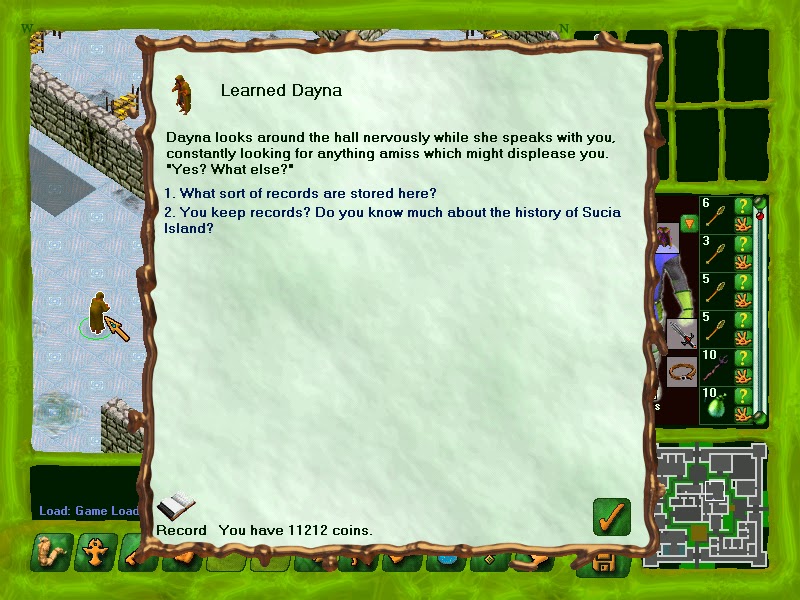
Geneforge is a cRPG released by Spiderweb Software in 2001, the company mostly known for their Avernum series. I bought this game on a whim since I am a fan of old cRPGs and had also played some Avernum back in the day, I didn't know anything about Geneforge though, I had never even heard of it. After having played some NWN and Baldur's Gate and gotten a bit fed up with the overly convoluted character development and combat systems I hoped that Geneforge would offer the same kind of fun I had with Planescape: Torment, and was very happy to find out it was definitely not far from.

Technically a picture from Geneforge 2 - geneforge.wikia.com


Geneforge is far from perfect though. First of all it's so ugly, its mama had to feed it with a slingshot as a baby. When I first started playing it I was sure it was from the mid-90s rather than the early 00 and I was shocked to find out it was actually from this side of the millenial divide. This is the same year the PC got Max Payne and Diablo 2 for comparison! It's important to remember that there is a difference between bad and bad graphics though. I know tons of people who complained about the graphics to Minecraft until they actually tried it and realized it was a perfect fit for the gameplay of the game. On the other hand I can't get myself to play a game like Don't Starve, solely because I don't like the visual style of the game (yes, call me shallow). Geneforge on the other hand is what you could call the ugly game with the good personality and eventhough I am sure the game would've been even better with better graphics, it didn't bother me in any way. It's ugly but very functional, it's easy to see what everything is supposed to be and I didn't find it any more dull than the graphics in NWN which eventhough more detailed still suffers from repetitiviness (damn that word btw).

The only time you'll hear music


The sound effects are if possible even worse than the graphics, and sound like something straight out of a 10 year olds first attempt in RPG-maker, if even that. If the graphics are one-sided the sound effects are even more so, and there is not a single musical track in the game except for on the title screen (which is a pretty good tune though). I can defend the graphics, but I can definitely understand why someone would have trouble with the sound in the game. Personally I didn't have a problem with them but the same effects get used a lot so if you're prone to being irritated by things like that then Geneforge might get on your nerves pretty quickly. I thought the few sound effects that were put into the game were fairly well chosen and eventhough you hear the same thing over and over it kind of just blends into the background. I have no idea why Spiderweb Software decided to do this, and my only guess is that they were on a limited budget and had to prioritize other things. Apparently it is something that Spiderweb Software are somewhat known for and I've got to say, in Geneforge they've definitely put their eggs in the right basket because gameplay and story make up for all the wrong of the graphics and sound effects.

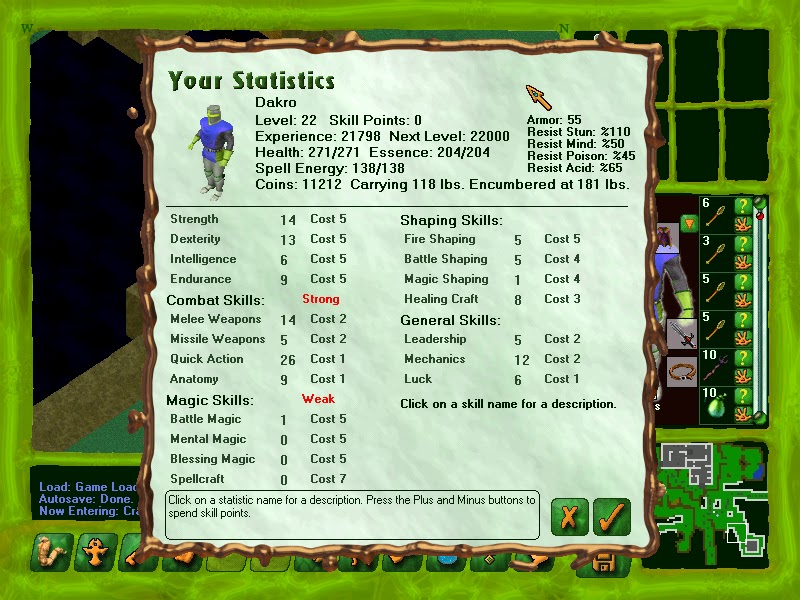
First of all, characters creation and further development doesn't feel half as convoluted as in other 90s cRPGs. Eventhough every stat probably isn't equally useful, I never got the feeling you could screw yourself over as easily as you can in some cRPGs and it definitely did not require some previous knowledge or reading of a guide book to get through. You play as a Shaper, a sect of people that create beings to do their bidding. For the game you can choose to play what basically boils down to "caster", "fighter" "caster-fighter" (although they're called "Shaper", "Agent" and "Guardian" in the game). I played as a Guardian, because having been burnt from other cRPGs I tried to choose whatever seemed to be the easiest class. Casters have a tendency to be ridiculously difficult in early game and possibly overpowered in later game so I wanted something that could fend for itself a bit. Because of this I can't speak for the viability of the other classes, but I did get the feeling that they were fairly well balanced as there were enemies that were easy for me to take down as a melee and some that were easier as a caster. Combat, which is turn based and uses action points, felt well designed and rewarding overall. As mentioned, some enemies were no problem for me and some required a lot more careful tactics and use of items, which I put down to choice of approach. My conclusion was that I will definitely try for a caster when I play Geneforge 2 because quite frankly melee classes aren't much fun in the early cRPGs since they don't get many skills to use. The same is true in Geneforge, lucky then that I also had the possibility to cast spells, use wands and other ranged weapons when necessary.

If only they were all so eager to please.


The controls are simple enough and the game has a really good pathfinding AI which allows you to get through larger areas you've already traversed without having to lead your character through the entire place. Only in a few instances did I fumble with accidentally pressing my own character (which skips my turn) instead of the enemy, if they stood close. Otherwise it was easy to learn how to use skills, items and swap gear in combat and I never felt like I failed because the controls worked against me.

One of the things that made me really happy, and especially compared to games like NWN and Baldur's Gate, was that Geneforge gives you a decent amount of experience for killing things. Leveling went quickly at first, then stagnated somewhat and went quickly again towards the end as enemies became silly difficult. The difficulty can get a bit even but not annoyingly so. I actually had to turn down the difficulty to "easy" towards the end (another feature that is very welcome). Some enemies that were difficult to me didn't rewards much experience and vice versa, which I put down to choice of class. I would've probably had a completely different experience of challenge with another class, but overall the game gave me a definite feeling of good combat design.


The story starts out simple enough, you're stranded on an island that turns out to be barred for reasons unknown to you. As you try to find a way off the island you get further invested into the history of the island and it all ends (without any spoilers) with some interesting choices for you to make. What I really liked about the story is how it unfolds and becomes more intriguing as you move on. You naturally stumble into things and have to draw conclusions from what you find, read and the people you talk to in a way that compares to a well written novel. Only in one instance did I think I had screwed myself over and couldn't continue, but I managed to solve it within a couple of minutes(turned out I had just not been observant enough). There is no better feeling than to randomly manage to solve a quest because you were curious and bold enough to venture into a cave and rummage around the angry ogres bed. Quests can also be completed retro-actively of course.

I was happy to see many good both male and female characters in the game and the dialogue is overall interesting enough for you to want to read it through and not just skip through. The story is presented to you as pop-up text whenever you enter an area of interest, and sometimes in books lying around, but is portioned up well enough to keep you interested without being intrusive or feel like it takes away too much time from actual gaming.


Common for these types of games, shop keepers have a finite amount of gold, which means you can drain your favorite shop keeper of all their money and sometimes have to travel around to be able to sell your stuff. This wasn't much of a problems thanks to a fast-travel system, it just required a bit of memorizing of areas. Unlike many other RPGs, you don't really lug around "junk" to sell, rather you find gems or combat items that you don't really need to sell. Uncommon however is that most gear is found, rather than bought, but as much as I love digging around for a tiny upgrade I welcomed this more streamlined approach as the gear was "handed out" with good intervals unlike in NWN where I barely ever got an upgrade and everything you could buy was well out of my monetary reach and just served to mock me.


What Geneforge really succeded was that, without making me feel overpowered, it made me feel like I was powerful and always stood a chance. If one area was too difficult there were often several others for me to try as the map quickly forks out into different directions for you to explore. It made me feel like I could make my own choices rather than being led around and like I was pushing the story forward rather than the story pushing me forward. I would love to see a graphical remake of this game but it definitely still holds up. I had loads of fun with it and I could recommend it to anyone that would enjoy a slightly less convoluted old-school cRPG with an original story.

Time played: 33 hours
Final score: 9/10

Saturday, July 11, 2015

We Need More World-Events

In my line of work I often meet people (mostly teenagers) who share my love and enthusiasm for video games and we often end up both playing and talking a lot about them. The other day I got to hang out with a guy who was playing Runescape (among other things) and he told me a bit about it. It seems like a cool game in general although extremely grindy (apparently quests of the sort "kill 100 of these" are standard. Yes 100, that's no exaggeration) but one thing in particular stuck in my mind. He told me of an event that, if I understood correctly, happened pretty recently in-game as part of an update/expansion to the game. Players were asked to hand in buckets of sand (and possibly other things the kid didn't mention) and in the end an island (or possibly beach) emerged in the game that hadn't been there before - complete with new places to skill up different professions or techniques. Now if you happen to play Runescape and know I got that all wrong, what matters is that it got me thinking about inclusion in video games and that it is the one thing that really sets MMO's apart from your every day singleplayer game.

And they say WoW graphics are outdated (Runescape in 2007) - forums.zybez.net


It might sound weird to talk about inclusion when talking about video games, because in essence video games are all about inclusion. Their interactive nature naturally invites the player to feel included and feel like they affect what happen around them (more or less). But MMO's can provide inclusion on a different scale, one in which the individual (that is you) gets to truly feel like they are part of something bigger and like they made a difference in the world around them.

Looking at a game like World of Warcraft, Blizzard have always known the power of this and allowed players to feel included in every expansion they released. Instead of just telling players there was a new expansion coming, they allowed us to experience it and take part of it through special events in game. One of my favorites was the massive event that preluded the opening of Ahn'Qiraj. Back then I had just started playing and was far from a raider, so I had little understanding of what was going on other than that everyone, from a low level casual scrub like me to the hardcore raiders, regardless of faction, united to achieve a common goal. There was something to get for everyone, you didn't have to be part of a big guild or know a lot of people who played - you just needed to take part in the event. It just felt magical to be part of something as massive as that undertaking. The event included gathering a vast variety of items and hand them in, but everyone could chip in and that was the important part.

You had to be there - imagekb.com


And the events that lead up to Burning Crusade and Wrath of the Lich King were similar huge folk festivals where everyone seemed to stop what they were doing and come together to achieve the same goal regardless of whether you were a pvp:er, raider or quester. My rose tinted goggles will allow me to ignore the fact that Blizzard obviously cleverly designed the events to entice these different groups to come together, but that is exacly what good game design should do.

I think this is different from multiplayer games in general, where you obviously also see a bunch of people work together (hopefully) for a common cause. Most importantly because these MMO events offer change - they allow the player to take place in changing the world that they live in rather than just repeating an action (like any multiplayer shooter for instance where the same goal is achieved or failed over and over without permanent change, similar to the seasonal events or pvp done in WoW.)

Party with the dead - wow-one.com


Could you implement something similar in a singleplayer game? Would we even want that? I am thinking both yes and no. On the one hand I always think it's interesting to see how you could develop new gaming experiences, on the other hand I feel like singleplayer and multiplayer games deliver very different gaming experiences and that's ok. Naturally there are things in multiplayer you can't do in singleplayer and vice versa and I doubt you could conjure the same feeling of scale in a singleplayer game as you could in a multiplayer, unless you somehow managed to hook up singleplayers making it a sort of inbetween like Dark Souls. Could you make multiplayer games other than MMOs adopt this idea? Could a game like Team Fortress 2 or CoD include this kind of gameplay? I am sure they could, in fact I would love to see it be done more often. Instead of just giving players a new map/arena/whatever, you could have an in-game event regarding it. Whether it would go down well or people prefer things to be as static and predictable as possible in these kind of settings I don't know - personally I would love a bit of gameplay diversity (which might be why I don't play those kind of games much).

And what kind of content should have these kind of world-events? Anything? Free stuff or pay for stuff? It worked in WoW to have everyone engage in a world-event that essentially preceded something that you still had to pay for to experience but I am not sure that works in any kind of game. But I am probably getting way ahead of myself here.

I haven't played enough other MMO's to know to which extent they incorporate this kind of gameplay, I can't recall anything like it in the few months I played Warhammer though. I do realize it is probably a huge undertaking for a game developer to try to achieve but the reward must surely be worth it. I can only speak for myself but all of the world-events I took part in in WoW, which was pretty much all of them from Vanilla to early MoP, became some of my fondest and best memories of the game.

My personal opinion is that the experience got watered down as WoW progressed, but it might also just be that every new world-event became less and less of a big thing for me. It was just another expansion with another world-event. I like to think that is not the case and I'm not that jaded, but rather that Blizzard included the players less and less. If I compare the level of player commitment required for the Ahn'Qiraj event with that of the Mists of Pandaria event... wait, did MoP even have an event? I can't remember it if it did. But Ahn'Qiraj wasn't even for an expansion, just another (or technically two) new raids. In Burning Crusade we got to work together to unlock the Sunwell Isle. I would've loved to see more events like that, that changed parts of the game, big or small. To me nothing else ever came close to making the world feel as alive, real and worthwhile as those all-player-including world-events ever did.

Monday, June 15, 2015

Baby & Game (Part 2 - All Fun And Games)

A couple of years ago I read Jane McGonigals book "Reality Is Broken" and eventhough I wasn't overly fond of the book in particular (you can read about it here) I did like the core concept - that through presenting seemingly dull tasks as fun games there is a lot of manpower to be put into useful things. As an example I remember a game that allowed "players" sort through thousands of snippets of old documents found by archaelogists, marking the ones that had letters on them (and which letters), thus saving the actual archaeologists tons of time. I tried this game myself and it wasn't fun, or should I say ellaborate, enough to spend hours on (but then some game concepts are very simple yet keep you hooked) but good enough to jump in every now and then. Even if only a couple of thousand people try it out and spend in total an hour playing it, there is alltogether a lot of time saved for what in reality is a menial task. Hence, Reality Is Broken. The title is actually quite catchy, since it pinpoints something crucial about the world around us. It's easy to make things boring, but it's also not that difficult to make things more fun.

Personally I've noticed that trying to make things more fun for yourself is a much more difficult task than to do it to someone else or have someone else do it for you. Maybe it's a bit like tickling, where it just doesn't work if you try to do it to yourself. Anyone who's tried it knows that sticking to a diet, gym regime or quit smoking all by yourself is a lot trickier than when you have friends who're in it with you. Or if you have some sort of app that allows you to track your progress. I mentioned to a friend at work the other day that the way she was tracking points and progress on her diet was a lot like a game. You're presented with a challenge that you need to overcome and the app gives you clear visual feedback on your progress, something that might be difficult to see if your just checking the scales. I know there are apps that do similar things for smoke-quitters - tracking how much money you've saved and "life you've gained". I once tried a browser game that was meant to make daily chores more fun in allowing for my character to level up and become stronger if I managed to do the laundry and dishes, or die if I failed (I died pretty early on...).

So eventhough the book was so-so, I am a big fan of the idea that by making things more gamey, ie fun, there is a lot that can be accomplished. Both on a society-scale and a personal-scale. I am sure you've also had the thought "if only I put all these hours into a degree/learning an instrument/learning another language/actually writing that book I always wanted to write I'd probably be rich by now". I read the book before I decided to try for a kid and I had embraced the idea long before I read the book but I also think I had fused the two in my head a long time ago. That having a kid could in many ways be seen as playing a game. I made the comparison to Tamagotchi in a post once, and mentioned then that I obviously understand that having an actual child is a lot more serious than "just" playing a game. After all it's another person we're talking about here, not my personal object of entertainment. Unlike a game, a kid is not something to give attention to when you feel like it and ignore when you don't. Nerdraging and rage quitting are not options you should consider. Rather than seeing child-raising as a game, I tried to think about how game-playing could affect my interactions with my child.

If you think about it, they do have a lot in common. There are things you do in games that aren't in themselves particularly fun but that you do anyway because the overall goal is worth it (ie grinding for an item). In the same way there are things you need to do with a child that aren't in themselves particularly fun but that you do anyway because it makes you happy to see your child happy (ie change diaper, read the same book/play the same game for the hundredth time). Most importantly, gaming requires a lot of patience. After having died 150 times to the same boss (yes, it happens), after having failed with the same platforming jump for the 30th time, after having spent 20 minutes on trying to crack a puzzle - having fun will give you the patience you need to give it another go.

Having a 1,5 year old, I realize that whether I say "yes" or "no" about something really comes down to patience. No I don't have the patience to make sure you don't break these things, so I'm not going to let you see them. No I don't have the patience for this to take three times more time, so I am not going to let you "help" me. No I don't have the patience to make sure you don't hurt yourself, so I am not going to let you go there. I decided early on I wanted to avoid saying no to my son just because I didn't have the patience to do it. I wanted my "no's" to mean something to him, hopefully making him understand that when I do say no, it's because it really means no, not because mommy doesn't feel like it. And dealing with a child really requires immense amounts of patience. Even if they're completely well behaved they can require so much energy. It also requires so much more patience since you're dealing with someone who has no concept of time and has very little patience of his/her own.

That's why I figured I would probably do us both a favor if I tried to make things more fun, for myself and for him. It definitely helps that I have the time to not have to rush things, I imagine it'll be a new challenge once I am pressed for time, trying to get to work while getting kid and everything else ready (that'll probably be matters for a future post). But now I have the time to let him help out with cleaning, in fact he has so much fun doing something I find quite boring, it gets more fun for me to do as well. Because he loves watering the plants it actually gets done every now and then, I used to forget about it until my plants started turning dangerously yellow (I am sorry!). Because he loves throwing things in the bin we don't have crumpled papers (like receipts) lying around anymore (and have sadly lost some other things when not looking). We can make a game out of putting away things when you're done with them, getting dressed, brushing your teeth (works some of the time at least), sweeping the floor (he loves that too). If he is having fun with it, I don't have to see it as a chore and it's a lot easier to have patience and energy for it. And to be fair I might as well make the most of it while he thinks it's fun, because I am pretty sure that won't last for much longer.

And obviously not everything is fun and games all the time. I can't have my kid help me with everything (like cleaning the toilet) and I can't be available 100% of the time (he still doesn't really get why I need to go to the bathroom). But the mindset definitely helps offsetting a lot of frustration.

In essence, I think games have taught me not to see an unhappy child as an obstacle but as a challenge, an opportunity for me to learn something and maybe try something different. They have helped me to keep my focus on the goal rather than to feel stuck at a problem, knowing that eventually I will get to the reward even if it feels like hard work at the moment. Those countless wipes in WoW definitely helped me forge that way of thinking and I actually think it has helped me in my everyday life.